Former Fed chief warns that the housing market will continue to weaken but says sector has already posted its sharpest decline.
November 6 2006: 4:43 PM EST
WASHINGTON (Reuters) -- The U.S. housing market will weaken further, but the sharpest decline is over as inventories of unsold homes decrease, former Federal Reserve Chairman Alan Greenspan said on Monday.
"This is not the bottom, but the worst is behind us," Greenspan said at a conference organized by financial services firm Charles Schwab.
Greenspan retired from the U.S. central bank in January, but his comments have still had the power to move financial markets.
A decline in U.S. home sales and construction has contributed to an overall slowing of economic growth to 1.6 percent in third quarter. But Greenspan said housing market activity is likely no longer to be a drag on overall economic growth as unsold inventories clear out and stabilize against sales levels.
The slowdown has hurt profits and sales for the nation's major homebuilders, including Pulte Homes (up $0.08 to $30.18, Charts), Centex (Charts), D.R. Horton (Charts), Lennar (Charts), K.B. Home (Charts) and Toll Brothers (Charts).
Fed policy-makers are watching closely to see if the slowdown in the economy will ease a little of the worrisome upward pressure that a tight labor market has been exerting on prices. Fed officials have said they are confident the housing slowdown has not spread into other areas of the economy and that slightly higher rates of growth will return in 2007.
Hopes for Fed rate cuts die
The former central banker said he is "reasonably confident" the United States will not slide into recession because businesses appear to be strong, as evinced by strong corporate profit margins and healthy levels of capital investment.
Greenspan, whose every move as Fed chairman was scrutinized for clues about monetary policy and the economic outlook, laid to rest the legend that Fed interest rate decisions could be divined by how full his briefcase appeared to be when he went to work.
"The extent to which my briefcase was fat or thin depended on whether my wife had time to make me lunch," he said.
On interest rates, the former Fed chair cautioned that global factors that helped push down long-term interest rates, fueling the U.S. housing boom of the early part of the decade, are not permanent features of the economic landscape.
Greenspan once famously described the phenomenon of stubbornly low long-term interest rates, despite the Fed's steady increases in short-term benchmark rates, as a conundrum.
On Monday, he said that forces such as a flood of new workers into the world economy after the collapse of communism and the global integration of China were one-time events that will eventually stop playing a role in keeping long-term interest rates as persistently low.
"There is a turning point but I don't know where it is," he said.
Wednesday, November 08, 2006

Might Have to Wait til 2008 to Relax

High-End or Starter Homes, Builders Remain in a Slump
By EDUARDO PORTER
Published: November 8, 2006
Two of the nation’s major home builders reported dismal results in their most recent quarters yesterday, confirming that the slump in the once-hot housing market is far from over.
Toll Brothers, the country’s largest builder of luxury homes, said revenue from home building fell 10 percent, to $1.81 billion in its fourth quarter, ended Oct. 31, compared with $2.01 billion in the period a year earlier. The results are preliminary; the company will report earnings on Dec. 5.
Toll Brothers’ backlog of projects declined 25 percent and its signed contracts plunged 55 percent as the company suffered from a rash of cancellations concentrated in the formerly hot markets of Florida and Northern California.
“I don’t think we can call where the floor is,” said Joel Rassman, chief financial officer of Toll Brothers. “We have not seen a turnaround yet.”
The decline was not limited to the luxury segment of the housing market. The Atlanta-based Beazer Homes USA, a smaller rival that builds many homes for first-time buyers, reported that net income fell 44 percent, to $91.9 million, or $2.19 a share, in the quarter ended Sept. 30, from $164.4 million, or $3.61 a share, in the period in 2005.
Revenue increased 4 percent, to $1.88 billion. But new orders plummeted 58 percent, and the company forecast a substantial decline in earnings for 2007.
More than a year into a housing market bust, the home builders’ deteriorating fortunes are hardly a surprise. In September, sales of both new and existing homes were running around 14 percent below their level a year earlier.
Home prices have not fallen uniformly across the nation; in some areas, they have, however, declined steeply. By September, the average price of a newly built home was about 2 percent below the price of a year earlier, according to government figures.
Stuck with unsold inventory that is the equivalent of more than six months of sales, builders have slammed on the brakes. New-housing starts in September were running about 18 percent below their level in September 2005.
Toll Brothers, which is based in Horsham, Pa., cut its forecast for home deliveries in 2007 by 9 percent to 10 percent, compared with its previous forecast. And it trimmed its portfolio of land to 74,000 lots, 19 percent below its high in the fiscal second quarter, which ran from February through April.
James O’Leary, chief financial officer at Beazer Homes, said the company reduced its number of lots by 15 percent in the quarter. It also cut about 1,000 jobs in September and October, about 25 percent of the company head count.
The slump in construction has hurt the broader economy. Residential investment, which accounts for about 5 percent of the nation’s total economic production, plummeted 17.4 percent in the third quarter of the year, according to government data. It was the biggest quarterly decline in more than 15 years, single-handedly reducing the growth in gross domestic product by roughly 1.1 percentage points.
Mr. Rassman at Toll Brothers argued that the housing market’s chill is a question of confidence, “led by the consumer being afraid” that prices might fall. But he argued that still-low interest rates combined with continued employment growth should eventually feed through into growing demand for homes.
Economists, however, point out that it will take some time for builders to clear out their bloated inventory of unsold houses — a requisite for them to break their fall. With home prices still high by historical standards compared with potential buyers’ incomes, this may be a protracted process, requiring more income gains or price declines.
Richard DeKaser, chief economist at the National City Corporation, predicted that it would take about 9 to 12 months for the supply and demand of homes to come back into balance. “We are probably two-thirds of the way down the slope,” Mr. DeKaser said. “The bulk of the decline is behind us, but we are not yet out of the woods.”
Wednesday, September 13, 2006
Housing decline to bottom out in mid-2007, says industry group
Marketwatch - September 13, 2006 7:16 PM ET
WASHINGTON (MarketWatch) -- A downswing in home sales and building should bottom out sometime during the middle of 2007 before recovering in the latter part of 2008, a home-building industry economist said Wednesday.
In the meantime, said another economist, consumers shouldn't expect a "widespread" bust in home prices as some of the strength begins to dwindle from regional housing markets.
The National Association of Home Builders' David Seiders and the Federal Deposit Insurance Corporation's Richard Brown were among four economists testifying Wednesday before two Senate Banking subcommittees' hearing about the housing bubble and its implications for the U.S. economy.
All four -- including analysts from the National Association of Realtors and the Office of Federal Housing Enterprise Oversight -- agreed housing activity is slowing. Economists added the slowdown poses some risks to the U.S. economy but that a drop-off in activity isn't nationwide.
Seiders said a "below-trend" performance for home sales and building is likely over the next two years.
"The downswing in home sales and housing production should bottom out around the middle of next year before transitioning to a gradual recovery that will raise housing market activity back up toward sustainable trend by the latter part of 2008," Seiders told the subcommittees in prepared testimony.
Brown, meanwhile, told senators that historically, widespread price busts haven't necessarily followed price booms.
But, he cautioned, today there are more boom markets than in the past, and more consumers who have borrowed using "nontraditional" mortgage products, like interest-only loans.
"Borrowers who took on nontraditional loans as a means to afford a more expensive home may be particularly vulnerable to adverse housing market conditions," Brown told the subcommittee in written testimony.
Mortgage applications up
Meanwhile, as the economists were acknowledging a slowdown in housing, another industry group was reporting that mortgage applications were up in the last week.
The number of applications for mortgages filed with major U.S. banks rose a seasonally adjusted 3.2% last week, the Mortgage Bankers Association reported Wednesday. See full story.
However, application volumes are still down 22.8% compared with the same week a year ago, in line with other data showing the nation's housing market cooling significantly. But applications have rebounded in recent weeks.
Applications for mortgages to purchase homes rose 5.3% on a week-to-week, seasonally adjusted basis, while applications for refinance loans increased 0.1%, the MBA's data showed.
The economic impact of the housing slowdown will vary by region, economists noted. Tom Stevens, the Realtors' president, said solid job growth in Florida, California, Arizona and other states should keep price declines short-lived "as new job holders provide demand and support for the housing market."
Overall, the impact of a slowing housing market on the nation's economy may be comparatively muted, said Seiders.
"The downswing in home sales and housing production will continue to detract from overall economic growth through mid-2007," Seiders testified.
"However," he said, "much of this negative impact should be offset by strengthening activity in other sectors of the U.S. economy, keeping GDP growth reasonably close to a sustainable trend-like performance."
Home price growth slows
Home prices grew at their slowest pace in six and a half years during the second quarter of the year, recently released government figures show.
Last week, the Office of Federal Housing Enterprise Oversight reported that home prices increased at a 4.7% annual rate during the second quarter. Prices had risen at an 8.8% annual rate in the first quarter and peaked at a 17.8% annual pace in the third quarter of 2004. See full story.
Ofheo director James Lockhart said the data are "a strong indication that the housing market is cooling in a very significant way."
Earlier Wednesday, Lockhart once again pressed Congress to pass reforms on Fannie Mae (FNM) and Freddie Mac (FRE), the two giant government-sponsored housing enterprises that are major sources of money for U.S. homebuyers. See full story.
Lawmakers have been working to fashion new rules following accounting scandals at both companies. Among the reforms being sought are a new regulator that would have authority to approve the issuing of new products by Fannie and Freddie, and a limit on the amount of mortgage-backed securities each company may hold. Some lawmakers and the Bush administration are concerned that the $1.4 trillion in securities held by the companies is too large and poses a risk to the U.S. financial system.
Congress's reform effort has been stymied and faces uncertainty as lawmakers prepare for elections in November.
Echoing Lockhart, Ofheo's chief economist told senators Wednesday that healthy housing markets could "soften seriously" from unexpected disruptions at Fannie and Freddie. "While both companies have made progress [on reform], much more needs to be done," said economist Patrick Lawler.
WASHINGTON (MarketWatch) -- A downswing in home sales and building should bottom out sometime during the middle of 2007 before recovering in the latter part of 2008, a home-building industry economist said Wednesday.
In the meantime, said another economist, consumers shouldn't expect a "widespread" bust in home prices as some of the strength begins to dwindle from regional housing markets.
The National Association of Home Builders' David Seiders and the Federal Deposit Insurance Corporation's Richard Brown were among four economists testifying Wednesday before two Senate Banking subcommittees' hearing about the housing bubble and its implications for the U.S. economy.
All four -- including analysts from the National Association of Realtors and the Office of Federal Housing Enterprise Oversight -- agreed housing activity is slowing. Economists added the slowdown poses some risks to the U.S. economy but that a drop-off in activity isn't nationwide.
Seiders said a "below-trend" performance for home sales and building is likely over the next two years.
"The downswing in home sales and housing production should bottom out around the middle of next year before transitioning to a gradual recovery that will raise housing market activity back up toward sustainable trend by the latter part of 2008," Seiders told the subcommittees in prepared testimony.
Brown, meanwhile, told senators that historically, widespread price busts haven't necessarily followed price booms.
But, he cautioned, today there are more boom markets than in the past, and more consumers who have borrowed using "nontraditional" mortgage products, like interest-only loans.
"Borrowers who took on nontraditional loans as a means to afford a more expensive home may be particularly vulnerable to adverse housing market conditions," Brown told the subcommittee in written testimony.
Mortgage applications up
Meanwhile, as the economists were acknowledging a slowdown in housing, another industry group was reporting that mortgage applications were up in the last week.
The number of applications for mortgages filed with major U.S. banks rose a seasonally adjusted 3.2% last week, the Mortgage Bankers Association reported Wednesday. See full story.
However, application volumes are still down 22.8% compared with the same week a year ago, in line with other data showing the nation's housing market cooling significantly. But applications have rebounded in recent weeks.
Applications for mortgages to purchase homes rose 5.3% on a week-to-week, seasonally adjusted basis, while applications for refinance loans increased 0.1%, the MBA's data showed.
The economic impact of the housing slowdown will vary by region, economists noted. Tom Stevens, the Realtors' president, said solid job growth in Florida, California, Arizona and other states should keep price declines short-lived "as new job holders provide demand and support for the housing market."
Overall, the impact of a slowing housing market on the nation's economy may be comparatively muted, said Seiders.
"The downswing in home sales and housing production will continue to detract from overall economic growth through mid-2007," Seiders testified.
"However," he said, "much of this negative impact should be offset by strengthening activity in other sectors of the U.S. economy, keeping GDP growth reasonably close to a sustainable trend-like performance."
Home price growth slows
Home prices grew at their slowest pace in six and a half years during the second quarter of the year, recently released government figures show.
Last week, the Office of Federal Housing Enterprise Oversight reported that home prices increased at a 4.7% annual rate during the second quarter. Prices had risen at an 8.8% annual rate in the first quarter and peaked at a 17.8% annual pace in the third quarter of 2004. See full story.
Ofheo director James Lockhart said the data are "a strong indication that the housing market is cooling in a very significant way."
Earlier Wednesday, Lockhart once again pressed Congress to pass reforms on Fannie Mae (FNM) and Freddie Mac (FRE), the two giant government-sponsored housing enterprises that are major sources of money for U.S. homebuyers. See full story.
Lawmakers have been working to fashion new rules following accounting scandals at both companies. Among the reforms being sought are a new regulator that would have authority to approve the issuing of new products by Fannie and Freddie, and a limit on the amount of mortgage-backed securities each company may hold. Some lawmakers and the Bush administration are concerned that the $1.4 trillion in securities held by the companies is too large and poses a risk to the U.S. financial system.
Congress's reform effort has been stymied and faces uncertainty as lawmakers prepare for elections in November.
Echoing Lockhart, Ofheo's chief economist told senators Wednesday that healthy housing markets could "soften seriously" from unexpected disruptions at Fannie and Freddie. "While both companies have made progress [on reform], much more needs to be done," said economist Patrick Lawler.
Wednesday, September 06, 2006
Tale of Two Cities
Have your say in the NY Sun's interactive State/Local Forum.
Is London the New New York? Or Is It the Other Way Around?
New York & London: Tale of Two Cities
By JILL GARDINER - Staff Reporter of the Sun
September 5, 2006
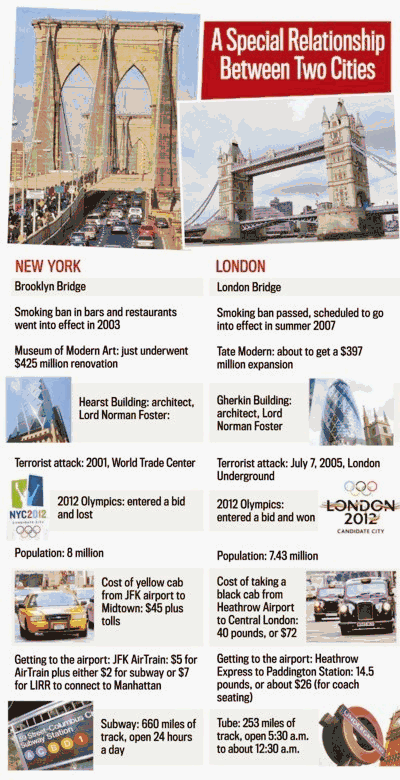
It's a city of nearly 8 million where Mayor Bloomberg owns a townhouse. Paul McCartney, Gwyneth Paltrow, and Madonna all own homes here, too. It competed to host the 2012 Olympic Games. Architects Daniel Libeskind, Norman Foster, and Richard Rogers are all working here or have recently completed buildings. Rupert Murdoch owns a big, conservative, tabloid newspaper here. The art scene is sizzling, real estate is super-pricey, and sushi-lovers can choose from at least two Nobu restaurants. The business world revolves around a big stock market and lots of new hedge funds.
The list of parallels between New York and London has always been long, but lately, with booming economies in both cities and trendy restaurants moving into old industrial neighborhoods, the two are looking more like mirror images.
Some say the two have more in common than any other international cities on the planet, making them both allies and, increasingly, competitors in the global economy.
In the past few years, both have been terrorist targets, competed for the 2012 Olympics (London won), and passed smoking bans for bars, pubs, and restaurants. London's ban, which is modeled after New York's, is scheduled to go into effect next year.
Academics, financial analysts, restaurateurs, art gallery owners, architects, and people who've lived in both cities say while London is still blatantly British in personality, its finance, restaurant, and art industries look more like New York's now than they did five to 10 years ago.
Tuesday, September 05, 2006

August 2006
A stretch of Fifth shakes off inferiority complex
Dub it whatever you want, but blocks of Fifth Avenue in 20s and 30s drawing higher-end retail as condos rise
By John Celock
Richard Cantor, principal of Cantor Pecorella, in front of 325 Fifth Avenue.
Maybe they should call it HiFi.
With a rise in condominium conversions and new residential construction, the section of Fifth Avenue north of Madison Square Park is in the middle of a changeover in its retail stock.
The area, which has long been considered a "no man's land" of vacant storefronts, Class B office space and wholesale retailers catering to decorators, has been a stepsister of the more famous posh Fifth Avenue shopping district 20 blocks north. In the past, retail spaces in the neighborhood have rented for as little as $20 a square foot.
Fifth Avenue between 23rd and 30th streets is now lined primarily with small showrooms for rugs, furniture, decorating supplies and art. The average for retail space in the area now is between $100 and $150 a square foot.
Yet with the arrival of new residential projects including Elad Properties' conversion of the 12-story Gift Building at 225 Fifth Avenue at 26th Street; the Chetrit Group's pending conversion of the 1.2-million-square-foot International Toy Center at 200 Fifth Avenue at 23rd Street; and the Clarett Group's 54-story Sky House rising at 11 East 29th Street, the neighborhood is beginning to see a transition in its retail spaces.
Concurrently, gentrifiers are attempting to find a name for the new neighborhood that will stick. The area, which is sandwiched among several successful real estate boomlets, has been alternately called NoFi (for "North of Flatiron") and SoFi (for "Southern Fifth").
"It has been a deep discount area and a deep manufacturing area," says Faith Hope Consolo, chairwoman of the retail leasing and sales division at Prudential Douglas Elliman. "It has struggled for an identity."
Currently, several retail vacancies dot the landscape between 25th and 27th streets: there are slots at 212 Fifth, 220 Fifth and 226 Fifth.
Consolo, who is handling leasing for 226 Fifth Avenue, says she expects the 1,000-square-foot space to be leased out within the next quarter. The space is currently asking $100 a square foot.
According to Patrick Breslin, president of the retail group at GVA Williams, retail on this portion of Fifth Avenue has long suffered in the shadows at the end of the tourist district at the Empire State Building, along with the shopping pathway leading toward Macy's and Herald Square to the west. The shops of the Flatiron District to the south have been a draw, with customers rarely venturing north.
Chase Welles, senior vice president with Northwest Atlantic Partners, says the changeover is centered now in development of service businesses for the new residents. Banks have been the first arrivals with restaurants beginning to arrive not that far behind.
The banks, including Chase Manhattan (which is leasing 6,000 square feet at the corner of Fifth and 27th), have been locked in bidding wars for the space, paying upward of $250 a square foot in some locations.
Welles sees the new retail spaces being not-too-upscale for the neighborhood, with the area becoming mainly a shopping district for residents, rather than a destination shopping district like Flatiron.
The new residential units are anchored on the northern stretch of the neighborhood by 325 Fifth Avenue, a 50-story condominium building built by Douglaston Development at 32nd Street.
Richard Cantor, principal of Cantor Pecorella, is handling the marketing of the building's residential units and three street-level retail spaces. Cantor's retail marketing strategy has been aimed at bringing in high-end stores for the new residents.
"That neighborhood is a hot area for your traditional Downtown purchaser," Cantor says, noting that the area is becoming an extension of Chelsea and Flatiron. "These are bankers and artists who want a hipper market."
Still, the complete demographic segment of the new residential population has not been completely determined; no definite breakdown can be given between singles and families. Cantor noted that at 325 Fifth, he has seen a wide mix of singles, families and childless couples purchasing units.
Two of the three retail spaces in 325 Fifth have been rented out to a gourmet deli and a hair salon, each paying $150 a square foot. The retail chain 7-Eleven, which offered 25 percent over the asking price to move into the third space, was turned down for not fitting the image the building's owners were looking for.
Cantor sees the third space going to a high-end retailer, most likely a service-related business.
Meanwhile, the decorating wholesalers who have long dominated this stretch of Fifth are beginning to relocate as they are priced out. Welles says many of them have begun to move east toward Madison Avenue and the various side streets, which have retail spaces renting out at prices more conducive to the wholesale decorating budget.
Industry watchers expect more street life in the future. "That part of Fifth at night was quiet," says GVA Williams' Breslin. "But now, with the new development and conversions around Madison Square Park, it will bring people into the neighborhood at night."
Joshua Strauss, managing director for Robert K. Futterman & Associates, agrees. "That was an in-between market with a little bit of office, a little bit of residential and a little bit of hotel," he says. Now, "it's a very hot area, despite what the street looks like."
impossible today to get a property of that scale in an urban location
Curbed Cheatsheet: Stuyvesant Town/Cooper Village Sale
Tuesday, September 5, 2006, by Lockhart
As was first rumored on Curbed back in July, MetLife officially put the 11,200 apartments that comprise Stuyvesant Town and Peter Cooper Village on the block last week. Presumed asking price: $4 billion to $5 billion. How'd the news imact around town? Let's see...
1) Awe. "No doubt in my mind. It’s truly an unprecedented offering and an irreplaceable property. It would be impossible today to get a property of that scale in an urban location. And that neighborhood has become so desirable." [NYTimes]
2) Disbelief. "Stuy Town's two-bedroom apartments have only a single bathroom. The walls of my place were so paper-thin, I got to know everything about my neighbors' family feuds and sex lives... An executive of one company among the prospective bidders said that 'in a normal market,' those weaknesses could seriously lower the price - 'but we're not in a normal market.'" [NYPost]
3) Wistfullness. "It does evoke sadness that more middle income people are going to be forced out of Manhattan. Another step toward Manhattan becoming an exclusive island for the wealthy. How long before Central Park is converted into a golf course?" [True Gotham]
4) Rebellion. "Stuyvesant Town is a middle-class community, and we do not want to lose that identity to the highest bidder." [NYTimes]
That last quote encapsulates today's news on the deal—that a group of residents, backed by the City Council speaker, will try to buy the two complexes to keep them affordable to the middle class. How to fund it? The AFL-CIO's housing investment trust could be used, at least to cover part of the price. Other ideas?
· Official Sees Way to Buy Two Developments [NYTimes]
· Coalition forms, hopes to keep apartment complex affordable [AP via IHT]
Tuesday, September 5, 2006, by Lockhart
As was first rumored on Curbed back in July, MetLife officially put the 11,200 apartments that comprise Stuyvesant Town and Peter Cooper Village on the block last week. Presumed asking price: $4 billion to $5 billion. How'd the news imact around town? Let's see...
1) Awe. "No doubt in my mind. It’s truly an unprecedented offering and an irreplaceable property. It would be impossible today to get a property of that scale in an urban location. And that neighborhood has become so desirable." [NYTimes]
2) Disbelief. "Stuy Town's two-bedroom apartments have only a single bathroom. The walls of my place were so paper-thin, I got to know everything about my neighbors' family feuds and sex lives... An executive of one company among the prospective bidders said that 'in a normal market,' those weaknesses could seriously lower the price - 'but we're not in a normal market.'" [NYPost]
3) Wistfullness. "It does evoke sadness that more middle income people are going to be forced out of Manhattan. Another step toward Manhattan becoming an exclusive island for the wealthy. How long before Central Park is converted into a golf course?" [True Gotham]
4) Rebellion. "Stuyvesant Town is a middle-class community, and we do not want to lose that identity to the highest bidder." [NYTimes]
That last quote encapsulates today's news on the deal—that a group of residents, backed by the City Council speaker, will try to buy the two complexes to keep them affordable to the middle class. How to fund it? The AFL-CIO's housing investment trust could be used, at least to cover part of the price. Other ideas?
· Official Sees Way to Buy Two Developments [NYTimes]
· Coalition forms, hopes to keep apartment complex affordable [AP via IHT]
Tuesday, May 23, 2006
Apartment market a bit worse than it looks
May 2006
Some Manhattan price and volume numbers stay high, but can't hide sharp inventory growth
By Tom Acitelli
Source: Miller Samuel Appraisers Manhattan's apartment market is now not moving up nor down, but rather "sideways," according to brokers and appraisers.
While the most recent apartment data shows what appears to be a continuation of the boom times -- with the median price of a Manhattan apartment and the average price per square foot setting records in the first quarter of 2006 -- the effect on the broader market is more ambiguous. Despite strong numbers posted as a result of Wall Street bonus money, the number of listings on the market -- and the time they stay there -- is climbing significantly.
The median sales price hit an all-time record of $825,000 in the first quarter, up 8.6 percent from the fourth quarter of 2005. The average price per square foot was $1,004, up $2 from the quarter before, according to a report from appraisal firm Miller Samuel and brokerage Prudential Douglas Elliman.
The number of sales jumped an impressive 27.4 percent, but the number of listings rose 16 percent over the quarter before and is up sharply from the same time last year -- by more than 60 percent.
"We have an upside on some of the statistics, but some of them are a little misleading," said Jonathan Miller, president of appraisal firm Miller Samuel. "I would characterize the market overall as moving sideways."
Miller said the annual wave of Wall Street bonus money boosted sales volume and gave the appearance of prices heading upward, but that was because those buyers purchased larger apartments.
"Like prior first quarters, this quarter was about the influx of Wall Street bonus money," he said. "You had a gain in market share of larger apartments. It wasn't that they were appreciating. It's that there were more of those types of units sold."
Fifty-one percent of all apartments sold in the first three months of the year in Manhattan were two-bedrooms or larger; that's up from 45 percent in the fourth quarter of 2005. Larger condos, especially, were popular among buyers. Nearly 60 percent of condo deals closed in the first quarter were for units with at least two-bedrooms, about a 12 percentage increase over the larger-condo market share in the fourth quarter.
Still, the most notable statistic Miller pointed out for the quarter was also the most gloomy -- the rise in listings on the market. There were 6,904 apartments available for sale during the first quarter, a huge jump from the same time last year.
"Probably the biggest story of the first quarter has been the surge of listing inventory," he said. "It's something other than mortgage rates we have to look at closely.
"The number of listings available for sale was up 60 percent over the same quarter last year," he added. "However, the 60 percent figure is somewhat exaggerated in that the prior year quarter results were at near record lows."
But there is a silver lining: Apartment prices are still ahead of last year. The average sales price for a Manhattan apartment stood at $1,300,928 at the end of the first quarter, up 9.6 percent from the fourth quarter and still up 7 percent over the first quarter of 2005, according to Miller Samuel.
Meanwhile, the average number of days it takes to sell an apartment increased slightly during the first quarter, going to 138 days compared to 137 the quarter before. That's well above the average of 94 days during the first quarter of 2005.
Prices of both co-ops and condos increased at the start of the year.
The average price of a co-op went up 7.2 percent over the fourth quarter to $1,093,361, according to Miller Samuel. The average price of a Manhattan condo went 7.1 percent higher quarter over quarter to $1,481,219. This figure still represented a dip compared to the first quarter of 2005, however.
And while the beginning of the year was about larger apartment sales as a result of Wall Street bonus money, brokers say the summer market will be about smaller apartments.
"Summer is usually a time for the smaller apartments," said Diane Ramirez, president of brokerage Halstead Property. "It's when people are looking to buy their first apartment or maybe even move up to their second one -- they tend to have a little more time at their workplaces during the summer. So they typically feel they can look more."
In three out of the last five years -- 2001, 2003, and 2004 -- sales closed have increased from the spring to the summer, though this may be more of a reflection of deals that went into contract in the spring, which is usually the strongest time of year in terms of sales.
In both 2003 and 2004, nearly 30 percent of all apartment sales in the borough closed over the summer, according to Miller Samuel. From 2001 through 2005, at least 24 percent of the sales for each year were summer deals.
Ariel Cohen, a broker with the Shvo Group, deals mostly with smaller apartments, two-bedrooms through studios. He said that, like Ramirez from Halstead, smaller apartments are going to dominate Manhattan summer sales. The sales market won't necessarily be any busier than it was in the first months of 2006, Cohen said, but will nonetheless be brisk. "It all depends," he said, "on what the price is."
Some Manhattan price and volume numbers stay high, but can't hide sharp inventory growth
By Tom Acitelli
Source: Miller Samuel Appraisers Manhattan's apartment market is now not moving up nor down, but rather "sideways," according to brokers and appraisers.
While the most recent apartment data shows what appears to be a continuation of the boom times -- with the median price of a Manhattan apartment and the average price per square foot setting records in the first quarter of 2006 -- the effect on the broader market is more ambiguous. Despite strong numbers posted as a result of Wall Street bonus money, the number of listings on the market -- and the time they stay there -- is climbing significantly.
The median sales price hit an all-time record of $825,000 in the first quarter, up 8.6 percent from the fourth quarter of 2005. The average price per square foot was $1,004, up $2 from the quarter before, according to a report from appraisal firm Miller Samuel and brokerage Prudential Douglas Elliman.
The number of sales jumped an impressive 27.4 percent, but the number of listings rose 16 percent over the quarter before and is up sharply from the same time last year -- by more than 60 percent.
"We have an upside on some of the statistics, but some of them are a little misleading," said Jonathan Miller, president of appraisal firm Miller Samuel. "I would characterize the market overall as moving sideways."
Miller said the annual wave of Wall Street bonus money boosted sales volume and gave the appearance of prices heading upward, but that was because those buyers purchased larger apartments.
"Like prior first quarters, this quarter was about the influx of Wall Street bonus money," he said. "You had a gain in market share of larger apartments. It wasn't that they were appreciating. It's that there were more of those types of units sold."
Fifty-one percent of all apartments sold in the first three months of the year in Manhattan were two-bedrooms or larger; that's up from 45 percent in the fourth quarter of 2005. Larger condos, especially, were popular among buyers. Nearly 60 percent of condo deals closed in the first quarter were for units with at least two-bedrooms, about a 12 percentage increase over the larger-condo market share in the fourth quarter.
Still, the most notable statistic Miller pointed out for the quarter was also the most gloomy -- the rise in listings on the market. There were 6,904 apartments available for sale during the first quarter, a huge jump from the same time last year.
"Probably the biggest story of the first quarter has been the surge of listing inventory," he said. "It's something other than mortgage rates we have to look at closely.
"The number of listings available for sale was up 60 percent over the same quarter last year," he added. "However, the 60 percent figure is somewhat exaggerated in that the prior year quarter results were at near record lows."
But there is a silver lining: Apartment prices are still ahead of last year. The average sales price for a Manhattan apartment stood at $1,300,928 at the end of the first quarter, up 9.6 percent from the fourth quarter and still up 7 percent over the first quarter of 2005, according to Miller Samuel.
Meanwhile, the average number of days it takes to sell an apartment increased slightly during the first quarter, going to 138 days compared to 137 the quarter before. That's well above the average of 94 days during the first quarter of 2005.
Prices of both co-ops and condos increased at the start of the year.
The average price of a co-op went up 7.2 percent over the fourth quarter to $1,093,361, according to Miller Samuel. The average price of a Manhattan condo went 7.1 percent higher quarter over quarter to $1,481,219. This figure still represented a dip compared to the first quarter of 2005, however.
And while the beginning of the year was about larger apartment sales as a result of Wall Street bonus money, brokers say the summer market will be about smaller apartments.
"Summer is usually a time for the smaller apartments," said Diane Ramirez, president of brokerage Halstead Property. "It's when people are looking to buy their first apartment or maybe even move up to their second one -- they tend to have a little more time at their workplaces during the summer. So they typically feel they can look more."
In three out of the last five years -- 2001, 2003, and 2004 -- sales closed have increased from the spring to the summer, though this may be more of a reflection of deals that went into contract in the spring, which is usually the strongest time of year in terms of sales.
In both 2003 and 2004, nearly 30 percent of all apartment sales in the borough closed over the summer, according to Miller Samuel. From 2001 through 2005, at least 24 percent of the sales for each year were summer deals.
Ariel Cohen, a broker with the Shvo Group, deals mostly with smaller apartments, two-bedrooms through studios. He said that, like Ramirez from Halstead, smaller apartments are going to dominate Manhattan summer sales. The sales market won't necessarily be any busier than it was in the first months of 2006, Cohen said, but will nonetheless be brisk. "It all depends," he said, "on what the price is."
Friday, December 02, 2005
Glad my family listens to me
Bryant Park back in fashion
Needle Park, R.I.P.: Area's residential renaissance includes prized views of spiffed-up square and spate of new projects
Not your father's Bryant Park: Ricardo Sobrevinas, president of the Bryant Park Place co-op, stands on the banister of the building's central staircase.
Ricardo Sobrevinas remembers the bad times on Bryant Park, when its most prominent feature was a floating population of drug dealers and their clientele.
Now the president of Bryant Park Place, the only co-op on the edge of the Midtown Manhattan park, Sobrevinas said the genteel way the park is now – a seasonal ice-skating rink was installed in October, outdoor movies are shown during warmer months, and much of the park has wi-fi for earnest cubicle dwellers from nearby office buildings – feels eons away from what it once was.
"There is no other building around Bryant Park that clearly parallels the experience of Bryant Park itself," said Sobrevinas, who has lived since 1995 in the co-op once known as The Columns. "Remember, Bryant Park was 'Needle Park.' Remember that? It used to be a drug haven. No one could go there safely."
The park's namesake co-op was also dangerous – financially. Sobrevinas said attorneys for would-be Bryant Park Place buyers would dissuade their clients from closing deals. Some apartments were simply uninhabitable, he added, and an entrenched co-op board, along with a managing agent eventually indicted, presided over a crumbling early 20th-century building originally constructed to grandly house Andrew Carnegie's Engineers Club.
In the late 1990s, though, just as the park across 40th Street began its revival, Bryant Park Place, too, under a revamped co-op board with Sobrevinas at the helm, underwent drastic improvements. The improvements, said a clearly proud Sobrevinas, have translated into financial advantages for the co-op's owners – 15 to 20 percent of which, he estimated, have been there since at least the early 1990s. A one-bedroom on the fifth floor sold for $145,000 in 2000. In late 2005, an apartment one floor below – "same layout," Sobrevinas said – sold for $670,000. A one-bedroom without park views now generally starts at $550,000. "In the mid-1990s," he said, "you could get them for $60,000."
This shift in the housing reality around Bryant Park has happened at the same time as – if not because of – a shift in the perception of the area. And developers and marketers have taken notice: At least four new condo developments are planned around the park's edges.
"Bryant Park today is probably one of the hippest neighborhoods in the city," said Michael Shvo, whose eponymous firm is marketing the luxury condos of the new Bryant Park Tower at 100 West 39th Street, the first such condos on the park. "Things are going in the nighttime, daytime, summer, winter."
Expected to open in January, Bryant Park Tower will feature a 24-concierge, a gym, on-site parking access, and a lobby designed by Costas Kondylis – unheard of amenities around Bryant Park only a decade ago. More than two-thirds of the tower's 94 units sold in four days in July. Half, according to the Shvo Group, sold for at least $1,300 a square foot.
The top 20 floors of 1450 Broadway, a 42-story office building at the southeast corner of 41st Street owned by the Moinian Group, are being converted to condos, said Shvo, whose group will be marketing them. The units will be ready for sale in about eight months. The rest of the tower will be left commercial.
The owners of the old headquarters of clothier Tommy Hilfiger at 485 Fifth Avenue plan to convert that 185,000-square-foot building into luxury loft condos overlooking the central branch of the New York Public Library. After buying the building in October, joint venture investors Belfonti Capital Partners and the Carlyle Group announced a $160 million conversion that would include a complete renovation of the building. While details of the conversion remain scarce, a spokesperson for the project did say that fashion designer Peter Som would design the interiors of the condos.
Finally, last month, Mermel & McLain Management and pension fund ASB Capital announced their $120 million purchase of the 20-story Springs Mills Building at 104 West 40th Street with plans to expand the 200,000-square-foot glass tower by 70,000 feet for apartments. Architects Skidmore Ownings Merrill have been signed up for the job, the New York Post reported.
Such hearty developer interest in the Bryant Park area seems almost routine now. It wouldn't have to Joy Greene some short years ago.
Greene, who's lived in Bryant Park Place since 1983, said "the area was rather unpleasant" until at least the early 1990s, when a redesign of the park added two restaurant pavilions, concession kiosks, and, perhaps most importantly, more entrances for a greater visibility that, along with a police crackdown, curbed rampant drug-dealing. By the late 1990s, then, she said, the shootings, drug dealing, and rat infestation of Bryant Park had decidedly given way to a more pleasant atmosphere.
"If you look at the gentrification over the last 20 years," Greene said, "it's really extraordinary."
Needle Park, R.I.P.: Area's residential renaissance includes prized views of spiffed-up square and spate of new projects
Not your father's Bryant Park: Ricardo Sobrevinas, president of the Bryant Park Place co-op, stands on the banister of the building's central staircase.
Ricardo Sobrevinas remembers the bad times on Bryant Park, when its most prominent feature was a floating population of drug dealers and their clientele.
Now the president of Bryant Park Place, the only co-op on the edge of the Midtown Manhattan park, Sobrevinas said the genteel way the park is now – a seasonal ice-skating rink was installed in October, outdoor movies are shown during warmer months, and much of the park has wi-fi for earnest cubicle dwellers from nearby office buildings – feels eons away from what it once was.
"There is no other building around Bryant Park that clearly parallels the experience of Bryant Park itself," said Sobrevinas, who has lived since 1995 in the co-op once known as The Columns. "Remember, Bryant Park was 'Needle Park.' Remember that? It used to be a drug haven. No one could go there safely."
The park's namesake co-op was also dangerous – financially. Sobrevinas said attorneys for would-be Bryant Park Place buyers would dissuade their clients from closing deals. Some apartments were simply uninhabitable, he added, and an entrenched co-op board, along with a managing agent eventually indicted, presided over a crumbling early 20th-century building originally constructed to grandly house Andrew Carnegie's Engineers Club.
In the late 1990s, though, just as the park across 40th Street began its revival, Bryant Park Place, too, under a revamped co-op board with Sobrevinas at the helm, underwent drastic improvements. The improvements, said a clearly proud Sobrevinas, have translated into financial advantages for the co-op's owners – 15 to 20 percent of which, he estimated, have been there since at least the early 1990s. A one-bedroom on the fifth floor sold for $145,000 in 2000. In late 2005, an apartment one floor below – "same layout," Sobrevinas said – sold for $670,000. A one-bedroom without park views now generally starts at $550,000. "In the mid-1990s," he said, "you could get them for $60,000."
This shift in the housing reality around Bryant Park has happened at the same time as – if not because of – a shift in the perception of the area. And developers and marketers have taken notice: At least four new condo developments are planned around the park's edges.
"Bryant Park today is probably one of the hippest neighborhoods in the city," said Michael Shvo, whose eponymous firm is marketing the luxury condos of the new Bryant Park Tower at 100 West 39th Street, the first such condos on the park. "Things are going in the nighttime, daytime, summer, winter."
Expected to open in January, Bryant Park Tower will feature a 24-concierge, a gym, on-site parking access, and a lobby designed by Costas Kondylis – unheard of amenities around Bryant Park only a decade ago. More than two-thirds of the tower's 94 units sold in four days in July. Half, according to the Shvo Group, sold for at least $1,300 a square foot.
The top 20 floors of 1450 Broadway, a 42-story office building at the southeast corner of 41st Street owned by the Moinian Group, are being converted to condos, said Shvo, whose group will be marketing them. The units will be ready for sale in about eight months. The rest of the tower will be left commercial.
The owners of the old headquarters of clothier Tommy Hilfiger at 485 Fifth Avenue plan to convert that 185,000-square-foot building into luxury loft condos overlooking the central branch of the New York Public Library. After buying the building in October, joint venture investors Belfonti Capital Partners and the Carlyle Group announced a $160 million conversion that would include a complete renovation of the building. While details of the conversion remain scarce, a spokesperson for the project did say that fashion designer Peter Som would design the interiors of the condos.
Finally, last month, Mermel & McLain Management and pension fund ASB Capital announced their $120 million purchase of the 20-story Springs Mills Building at 104 West 40th Street with plans to expand the 200,000-square-foot glass tower by 70,000 feet for apartments. Architects Skidmore Ownings Merrill have been signed up for the job, the New York Post reported.
Such hearty developer interest in the Bryant Park area seems almost routine now. It wouldn't have to Joy Greene some short years ago.
Greene, who's lived in Bryant Park Place since 1983, said "the area was rather unpleasant" until at least the early 1990s, when a redesign of the park added two restaurant pavilions, concession kiosks, and, perhaps most importantly, more entrances for a greater visibility that, along with a police crackdown, curbed rampant drug-dealing. By the late 1990s, then, she said, the shootings, drug dealing, and rat infestation of Bryant Park had decidedly given way to a more pleasant atmosphere.
"If you look at the gentrification over the last 20 years," Greene said, "it's really extraordinary."
Saturday, September 10, 2005
Rip from the Headlines
Bubble, we hardly knew ye
As the summer ends amid record housing prices, brokers expect a market correction, not a bubble
By Tom Acitelli
Leonard Steinberg and Hervé Senequier ask in their August newsletter a question that's preoccupied New York real estate all summer: "Bubble B.S.?"
The Prudential Douglas Elliman duo, who specialize in higher-end Manhattan real estate, declare in their monthly Luxury Letter that the notion of a housing bubble is an indefinable mishmash of too many statistics or just so much unsubstantiated pop psychology.
"There appears to be absolutely no tangible indication (so far) of any bubble-popping market behavior," the newsletter read. "In fact, quite the contrary. All of a sudden we are seeing more and more properties with asking prices hovering around the $2,000/sf mark... this just a few months after $1,000/sf pricing appeared average."
Recent figures about the Manhattan residential market would seem to buoy these conclusions, a welcome development for New York real estate bulls. While few have ever contended that today's market closely resembles the market of the late 1980s, which famously imploded, many acknowledge that some correction is in the offing. That correction will not constitute a bubble burst like the one of the early 1990s, however.
That means prices of $1,000-plus a square foot and a more than $1 million average for a Manhattan apartment should linger. With low inventory and record prices, the notion of a bubble and any subsequent burst becomes like the old riddle about a tree falling in the forest: If there's a real estate bubble and no one notices it because they're too busy buying and selling, does it truly exist?
"I would say that with the escalations we've had in the last two years, the obvious conclusion is bubble," Steinberg told The Real Deal. "But, sometimes, that which is obvious is wrong. What I think you see at the moment is an inflated bubble, but to know if it's really a bubble or not is to determine whether it deflates. Who cares about a bubble if it never deflates, right?"
It may be a while before anyone has to care.
The average sales price of a Manhattan condo or co-op was more than $1.1 million in July, 4 percent higher than the same month last year, according to a monthly report from Halstead Property. (Appraisal firm Miller Samuel found the number to be an even higher $1.3 million in its second quarter report released in July.) Halstead's numbers represent a 16-percent decline from June, however, but the report stresses the fluctuation of prices from month to month. The median price, a longer-term figure, was $725,000, the third-highest figure ever and a 12 percent increase over the past year, according to Halstead.
The median price per room for a prewar co-op in July was nearly $200,000, 24 percent higher than in July 2004, according to Halstead. For postwar co-ops, that price was nearly $183,000, a 27-percent jump over last year. For condos, the July numbers were, as usual, even higher. The median price per square foot for a prewar condo was $1,036 and, for a postwar, $1,007 – both increases over July 2004.
These high numbers show no signs of ebbing after the traditionally slow summer, even in less coveted areas of the city.
Downtown listings are fetching some of their highest median prices ever, according to Halstead. The median price for a one-bedroom there was $625,000 in July, 30 percent higher than last year. Two-bedrooms in Downtown hit a median price of $1.15 million in July, up 24 percent over July 2004.
These increases come as inventory decreased in Manhattan. The number of new listings in Downtown as well as on the East and West sides declined, generally, during July, according to Halstead. On the East Side, the decline overall was 20 percent from July 2004; on the West Side, it was unchanged from last year, though both one- and two-bedrooms, staples of the Upper West Side, declined by 7 and 8 percent, respectively. In Downtown, new listings declined by 6 percent over July 2004.
While scoring the market is difficult by month, the long-term upward trend could be the sum of buyer (and investor) confidence in Manhattan real estate, low mortgage rates in a relatively strong economy, and the absorption of new housing as it comes on the market.
Halstead chief economist Greg Heym said he doesn't see a current situation in which people have to sell – the necessary precursor for a bubble burst – especially compared to the last housing bust in the early 1990s, when job losses and a recession spurred selling at often weakened prices.
Unless the economy suddenly tanks or interest rates rise sharply, the bubble you've heard and read so much about may never materialize.
"It's like with some stocks," Heym said. "If people keep saying 'bubble,' they may start to believe it, despite any evidence."
As the summer ends amid record housing prices, brokers expect a market correction, not a bubble
By Tom Acitelli
Leonard Steinberg and Hervé Senequier ask in their August newsletter a question that's preoccupied New York real estate all summer: "Bubble B.S.?"
The Prudential Douglas Elliman duo, who specialize in higher-end Manhattan real estate, declare in their monthly Luxury Letter that the notion of a housing bubble is an indefinable mishmash of too many statistics or just so much unsubstantiated pop psychology.
"There appears to be absolutely no tangible indication (so far) of any bubble-popping market behavior," the newsletter read. "In fact, quite the contrary. All of a sudden we are seeing more and more properties with asking prices hovering around the $2,000/sf mark... this just a few months after $1,000/sf pricing appeared average."
Recent figures about the Manhattan residential market would seem to buoy these conclusions, a welcome development for New York real estate bulls. While few have ever contended that today's market closely resembles the market of the late 1980s, which famously imploded, many acknowledge that some correction is in the offing. That correction will not constitute a bubble burst like the one of the early 1990s, however.
That means prices of $1,000-plus a square foot and a more than $1 million average for a Manhattan apartment should linger. With low inventory and record prices, the notion of a bubble and any subsequent burst becomes like the old riddle about a tree falling in the forest: If there's a real estate bubble and no one notices it because they're too busy buying and selling, does it truly exist?
"I would say that with the escalations we've had in the last two years, the obvious conclusion is bubble," Steinberg told The Real Deal. "But, sometimes, that which is obvious is wrong. What I think you see at the moment is an inflated bubble, but to know if it's really a bubble or not is to determine whether it deflates. Who cares about a bubble if it never deflates, right?"
It may be a while before anyone has to care.
The average sales price of a Manhattan condo or co-op was more than $1.1 million in July, 4 percent higher than the same month last year, according to a monthly report from Halstead Property. (Appraisal firm Miller Samuel found the number to be an even higher $1.3 million in its second quarter report released in July.) Halstead's numbers represent a 16-percent decline from June, however, but the report stresses the fluctuation of prices from month to month. The median price, a longer-term figure, was $725,000, the third-highest figure ever and a 12 percent increase over the past year, according to Halstead.
The median price per room for a prewar co-op in July was nearly $200,000, 24 percent higher than in July 2004, according to Halstead. For postwar co-ops, that price was nearly $183,000, a 27-percent jump over last year. For condos, the July numbers were, as usual, even higher. The median price per square foot for a prewar condo was $1,036 and, for a postwar, $1,007 – both increases over July 2004.
These high numbers show no signs of ebbing after the traditionally slow summer, even in less coveted areas of the city.
Downtown listings are fetching some of their highest median prices ever, according to Halstead. The median price for a one-bedroom there was $625,000 in July, 30 percent higher than last year. Two-bedrooms in Downtown hit a median price of $1.15 million in July, up 24 percent over July 2004.
These increases come as inventory decreased in Manhattan. The number of new listings in Downtown as well as on the East and West sides declined, generally, during July, according to Halstead. On the East Side, the decline overall was 20 percent from July 2004; on the West Side, it was unchanged from last year, though both one- and two-bedrooms, staples of the Upper West Side, declined by 7 and 8 percent, respectively. In Downtown, new listings declined by 6 percent over July 2004.
While scoring the market is difficult by month, the long-term upward trend could be the sum of buyer (and investor) confidence in Manhattan real estate, low mortgage rates in a relatively strong economy, and the absorption of new housing as it comes on the market.
Halstead chief economist Greg Heym said he doesn't see a current situation in which people have to sell – the necessary precursor for a bubble burst – especially compared to the last housing bust in the early 1990s, when job losses and a recession spurred selling at often weakened prices.
Unless the economy suddenly tanks or interest rates rise sharply, the bubble you've heard and read so much about may never materialize.
"It's like with some stocks," Heym said. "If people keep saying 'bubble,' they may start to believe it, despite any evidence."
High times along the High Line
Where are the clients
New condos rise with park views
Christopher Mathieson, managing partner of JC DeNiro & Associates, stands above the future High Line park (right, background).
An elevated promenade could be the ribbon that unwinds through Manhattan's next hot neighborhood, changing what it means to live 'on the park.'
The area of West Chelsea around 10th Avenue to 11th Avenue, from 16th Street north to 30th Street, could in the next few years see some of the briskest condo development of any area in Manhattan. And much of that development will happen around what's being called the High Line, a 6.7-acre span of former elevated train track running 22 blocks ending at 34th Street that's expected to become a park.
Groundbreaking is slated by the end of 2005, and nearly $70 million in public funds has already been allocated for development.
The pending park and a recent rezoning of the area by the city have united like weather fronts over most of West Chelsea to help rain development on a neighborhood dominated by high-rise rentals and aging manufacturing and commercial space.
"Dating back 10 or 12 years ago, it was strictly kind of a gritty, warehouse area," said Stuart Siegel, managing director at Grubb & Ellis, which is marketing a new 20-story commercial condo building called the Chelsea Arts Tower on West 25th Street, an office and art gallery development among the many residential projects set to rise.
Siegel has worked in the area for more than a dozen years. "It was kind of a blighted area," he said. "Not much money had been spent in the buildings."
The site for the Chelsea Arts Tower, which is going up on a former parking lot, was bought for $9 million, said Siegel, who helped broker the land deal. The glass and concrete tower, set to open in early 2006, will feature galleries and terraces for exhibits and collections, with some of the space projected to sell for up to $1,000 a square foot.
Other developments bolster the story of West Chelsea's emergence.
There's 555 West 23rd Street, two new luxury rental buildings with 337 units being redesigned by Andi Pepper and Stephen B. Jacobs as condos. One-bedrooms, according to the New York Post, will start at $550,000 and two-bedrooms could go as high as $1.6 million. Douglaston Development topped out the buildings just this spring, making their short lives as rentals a telling example of the rush to capitalize on West Chelsea's changing residential face.
The former eyesore that's become a beacon for the neighborhood has lent its name to another bright spot, the Highline 519. The project at 519 West 23rd Street features 11 floor-through condos marketed by Prudential Douglas Elliman. Although it's about one block from its namesake, Andy Gerringer, director of Elliman's development marketing, said the Highline 519 was started more than two years ago, "before all the hoopla about the High Line became serious."
Studios there will start at around $700,000 and two-bedrooms may go as high as $1.75 million. These prices are well above Manhattan norms: The average sales price was $380,073 for a studio in the second quarter 2005, according to appraisal firm Miller Samuel, and $1.54 million for a two-bedroom.
The Related Companies is also planning a residential building between 16th and 17th streets on the east side of 10th Avenue, fronting the High Line. Further south, a new luxury hotel is planned at Little West 12th and Washington streets. Developed by Andre Balazs' Hotels AB, it will be dubbed the Standard, New York. Details remain scarce, but Polshek Partnership has been named as the architect.
Overall, between 7,200 and 10,000 new residential units may be built in West Chelsea in the next seven to 10 years, according to broker estimates. As many as 900 could spring up within a single square block, around 23rd Street between 10th and 11th avenues.
"It's really going to be creating a whole entire neighborhood onto itself," said Christopher Mathieson, managing partner at JC DeNiro & Associates, which is nearly doubling the size of its Ninth Avenue office in anticipation of the residential influx.
As Mathieson drove down the West Side Highway in early August, rolling past recent residential developments in the West Village, he posed a question he thinks many will soon ask about 10th and 11th avenues farther north.
"It'll be the same way for West Chelsea," he said, pointing out newer high-rises in the West Village. "People will say, 'Remember when nothing was here?'"
New condos rise with park views
Christopher Mathieson, managing partner of JC DeNiro & Associates, stands above the future High Line park (right, background).
An elevated promenade could be the ribbon that unwinds through Manhattan's next hot neighborhood, changing what it means to live 'on the park.'
The area of West Chelsea around 10th Avenue to 11th Avenue, from 16th Street north to 30th Street, could in the next few years see some of the briskest condo development of any area in Manhattan. And much of that development will happen around what's being called the High Line, a 6.7-acre span of former elevated train track running 22 blocks ending at 34th Street that's expected to become a park.
Groundbreaking is slated by the end of 2005, and nearly $70 million in public funds has already been allocated for development.
The pending park and a recent rezoning of the area by the city have united like weather fronts over most of West Chelsea to help rain development on a neighborhood dominated by high-rise rentals and aging manufacturing and commercial space.
"Dating back 10 or 12 years ago, it was strictly kind of a gritty, warehouse area," said Stuart Siegel, managing director at Grubb & Ellis, which is marketing a new 20-story commercial condo building called the Chelsea Arts Tower on West 25th Street, an office and art gallery development among the many residential projects set to rise.
Siegel has worked in the area for more than a dozen years. "It was kind of a blighted area," he said. "Not much money had been spent in the buildings."
The site for the Chelsea Arts Tower, which is going up on a former parking lot, was bought for $9 million, said Siegel, who helped broker the land deal. The glass and concrete tower, set to open in early 2006, will feature galleries and terraces for exhibits and collections, with some of the space projected to sell for up to $1,000 a square foot.
Other developments bolster the story of West Chelsea's emergence.
There's 555 West 23rd Street, two new luxury rental buildings with 337 units being redesigned by Andi Pepper and Stephen B. Jacobs as condos. One-bedrooms, according to the New York Post, will start at $550,000 and two-bedrooms could go as high as $1.6 million. Douglaston Development topped out the buildings just this spring, making their short lives as rentals a telling example of the rush to capitalize on West Chelsea's changing residential face.
The former eyesore that's become a beacon for the neighborhood has lent its name to another bright spot, the Highline 519. The project at 519 West 23rd Street features 11 floor-through condos marketed by Prudential Douglas Elliman. Although it's about one block from its namesake, Andy Gerringer, director of Elliman's development marketing, said the Highline 519 was started more than two years ago, "before all the hoopla about the High Line became serious."
Studios there will start at around $700,000 and two-bedrooms may go as high as $1.75 million. These prices are well above Manhattan norms: The average sales price was $380,073 for a studio in the second quarter 2005, according to appraisal firm Miller Samuel, and $1.54 million for a two-bedroom.
The Related Companies is also planning a residential building between 16th and 17th streets on the east side of 10th Avenue, fronting the High Line. Further south, a new luxury hotel is planned at Little West 12th and Washington streets. Developed by Andre Balazs' Hotels AB, it will be dubbed the Standard, New York. Details remain scarce, but Polshek Partnership has been named as the architect.
Overall, between 7,200 and 10,000 new residential units may be built in West Chelsea in the next seven to 10 years, according to broker estimates. As many as 900 could spring up within a single square block, around 23rd Street between 10th and 11th avenues.
"It's really going to be creating a whole entire neighborhood onto itself," said Christopher Mathieson, managing partner at JC DeNiro & Associates, which is nearly doubling the size of its Ninth Avenue office in anticipation of the residential influx.
As Mathieson drove down the West Side Highway in early August, rolling past recent residential developments in the West Village, he posed a question he thinks many will soon ask about 10th and 11th avenues farther north.
"It'll be the same way for West Chelsea," he said, pointing out newer high-rises in the West Village. "People will say, 'Remember when nothing was here?'"
The housing bubble? Glad you asked...
Where are the clients
During the past year or so, it seemed no expert or news outlet could stay mum when the housing market came up in the national conversation. Here is a digest of the speculation from major media regarding the much-disputed bubble.
In the headlines...
"America's House Party"
When people feel rich, they spend – whether their wealth is actual or merely on paper. It's called the wealth effect, and it's even more potent with housing than with stocks. Over the past three years, the wealth effect from rising home values accounted for a third of all growth in consumer spending, which was single-handedly responsible for keeping us out of recession for two years.
Although real estate is less volatile than stocks, there are troubling aspects to the real estate boom. At the stock market's peak, 1 percent of investors controlled about 33.5 percent of stock wealth; the top 1 percent of home-equity holders have only 13 percent of housing wealth. A broad drop in home values would affect a far larger cross section of Americans than did the NASDAQ bust. Complicating that danger, home buyers have turned to some risky strategies to afford their purchases. If enough homeowners become swamped by their debts and have to sell, prices would drop – creating a reverse wealth effect and exacerbating a slowdown. Time, June 5, 2005, Cover Story
"Will the walls come falling down?"
A fall in American house prices could be bad news not just for American homeowners, but for the rest of the world. Robust American demand has supported export-driven growth in many economies, particularly emerging markets and Asia. If American consumers have to raise their abysmal savings rate, exporting nations will feel the pinch.
Most worryingly, a collapse in American export demand could trigger a vicious cycle. In order to keep their currencies low against the dollar, and thus boost exports to America, Asian central banks have been accumulating dollar reserves, which they have poured into Treasury bonds. This has increased the supply of capital in America, and thus been at least partly responsible for the borrowing binge that fuelled the housing boom. If house prices fall, and suddenly poorer Americans have to cut back on their purchases, this will shrink the supply of cheap credit from Asian central banks, pushing up interest rates and causing house prices to fall even further. The Economist, April 20, 2005, Cover Story
"Is the Housing Boom Over?"
Over long periods home prices are tethered to two fundamentals: local rents and household incomes. Today something unusual is happening – even in this modest recovery, the rental market is extremely weak. The explanation is simple: The excitement around mining money from lots and shingles, coupled with the lure of low rates, is persuading people to buy houses even though rentals are, in many cases, a far better deal.
Since the mid-1990s, prices nationwide have risen an astounding 25 percent faster than rents. According to data from Fidelity National Financial, the ratio of house prices to rents now stands at 15.2, a 20-year high and a level that is simply unsustainable. As usual, the gap is most glaring in hot markets. In time, rents will exercise a gravitational pull on housing prices. Fortune, September 20, 2004, Cover Story
[Editor's note: Rents in about 85 percent of major metro areas have climbed in the last year, according to recent reports, changing the situation somewhat.]
"That Sinking Feeling – Is Your Apartment Like a Dot-Com Stock?"
The scariest aspect of today's real estate market is the conviction that houses are always a good investment. According to Miller Samuel, the median price of a Manhattan co-op has tripled since 1995, vastly exceeding the performance of, say, the S& 500, which has merely doubled. But the median Manhattan co-op also cost the same in 1999 as it did in 1981, eighteen years earlier. Over that period the S& 500 rose tenfold (before dividends!). New York Magazine, May 23, 2005, Cover Story
"An Iron Bubble: Housing Market Isn't Deflating"
Real estate in New York is unlike real estate in any other hot market: More than 80 percent of co-ops in the United States are located in New York, and co-op apartments make up about 80 percent of New York's residential real-estate market. The tendency of co-op boards to weed out speculative investors suggests New Yorkers are primarily buying property for personal ownership rather than to turn a quick profit.
And a Business 360 study concluded that the price of housing – still recovering from the early 1990s decline – is indeed undervalued. The report predicts price increases of 10 percent per year through 2007, followed by a 5 to 8 percent annual gain through 2010 – a slowdown, but only a decrease in the rate of increase. New York Observer, June 6, 2005, Front Page
From the experts...
"That Hissing Sound"
Many bubble deniers point to average prices for the country as a whole, which look worrisome but not totally crazy.
But Princeton economist Paul Krugman notes that the national average blends results from metropolitan areas like Houston and Atlanta – where it is easy to build houses and prices rose 26 and 29 percent, respectively – with results from areas like New York, Miami and San Diego – where population density and land-use restrictions make construction difficult and prices rose 77, 96 and 118 percent, respectively. In the latter areas, Krugman argues that it only makes sense to buy if you believe that prices will keep rising rapidly, generating big capital gains – which is pretty much the definition of a bubble. The New York Times, August 8, 2005
"The Bubble's New Home"
A price slide could begin at any time with the crescendo of "talk," contends Yale economist Robert Shiller. He uses the word to cover everything from the recent Time magazine cover story on the vertiginous rise in home prices and the popularity of cable-television shows about rehabilitating and investing in real estate to the breathless newspaper stories of Miami condos being "flipped" for profit a half-dozen times before construction even begins. To Shiller, the housing bubble grew out of the same irrational exuberance that gave rise to the 1995-2000 stock mania. That would perhaps explain why most of the housing bubbles around the globe occurred in countries that also had stock bubbles.
Housing busts often start almost imperceptibly and unfold slowly. They're difficult to detect in their early phases, in part because accurate price data on comparable-home sales is hard to come by. Homeowners often live in denial of market realities by listing their properties at unrealistic prices or simply taking their homes off the market to await better times. Shiller foresees a 20 to 25 percent cumulative decline in nominal prices (which works out to about an average of 2 percent a year over the decade). Barron's, June 20, 2005
"Bubble Debate Moves From 'If' to 'Where'"
Alan Greenspan recently described the U.S. housing market as a "collection of only loosely connected local markets" that have no direct pricing relationships and therefore harbor little national risk of a bubble. But what if the bubbles proliferate enough to make one big foamy mess?
The most overheated local housing areas in the U.S. – 22 major metropolitan markets – now account for 35 percent of the value of the country's residential real estate, up from 24 percent in 1995. It's such a large share of the total market that a sharp fall in their values could stall or slow national economic growth. The Wall Street Journal, June 20, 2005
From left field...
"Although a bubble in home prices for the nation as a whole does not appear likely," Greenspan began in that obsessively measured tone of his..." There do appear to be, at a minimum, signs of froth in some local markets."
Froth? What the heck is froth?... The largest single investment of most American families is now being compared to the top 2 inches of a Starbucks vanilla-almond latte? This is the solid economic foundation we're supposed to build our futures on? Ellis Henican, Newsday, June 10, 2005
Maybe this is the most ominous sign of trouble ahead in the real estate market: The Kiwanians have gotten into condos.
When real estate investor Warren Hickernell became head of fundraising at the South Sarasota Kiwanis Club, he wanted to try something different. He told his brethren right from the start: "I don't want to sell candy. I don't want to sell little trinkets. Here's what I do..." What he did was buy modest houses, fix them up, and sell them. The club agreed to put money into his deals. But a couple of years ago Hickernell stopped buying houses for the club. The problem? It was getting harder to find bargains. "Amateurs are running up the prices here," he says. "People are asking too much." So Hickernell came up with a new strategy. He found an old mom-and-pop motel and converted it to condos.
It sold out before the renovation was done, and now Hickernell and the Kiwanians are on their second motel. Fortune, September 8, 2004
During the past year or so, it seemed no expert or news outlet could stay mum when the housing market came up in the national conversation. Here is a digest of the speculation from major media regarding the much-disputed bubble.
In the headlines...
"America's House Party"
When people feel rich, they spend – whether their wealth is actual or merely on paper. It's called the wealth effect, and it's even more potent with housing than with stocks. Over the past three years, the wealth effect from rising home values accounted for a third of all growth in consumer spending, which was single-handedly responsible for keeping us out of recession for two years.
Although real estate is less volatile than stocks, there are troubling aspects to the real estate boom. At the stock market's peak, 1 percent of investors controlled about 33.5 percent of stock wealth; the top 1 percent of home-equity holders have only 13 percent of housing wealth. A broad drop in home values would affect a far larger cross section of Americans than did the NASDAQ bust. Complicating that danger, home buyers have turned to some risky strategies to afford their purchases. If enough homeowners become swamped by their debts and have to sell, prices would drop – creating a reverse wealth effect and exacerbating a slowdown. Time, June 5, 2005, Cover Story
"Will the walls come falling down?"
A fall in American house prices could be bad news not just for American homeowners, but for the rest of the world. Robust American demand has supported export-driven growth in many economies, particularly emerging markets and Asia. If American consumers have to raise their abysmal savings rate, exporting nations will feel the pinch.
Most worryingly, a collapse in American export demand could trigger a vicious cycle. In order to keep their currencies low against the dollar, and thus boost exports to America, Asian central banks have been accumulating dollar reserves, which they have poured into Treasury bonds. This has increased the supply of capital in America, and thus been at least partly responsible for the borrowing binge that fuelled the housing boom. If house prices fall, and suddenly poorer Americans have to cut back on their purchases, this will shrink the supply of cheap credit from Asian central banks, pushing up interest rates and causing house prices to fall even further. The Economist, April 20, 2005, Cover Story
"Is the Housing Boom Over?"
Over long periods home prices are tethered to two fundamentals: local rents and household incomes. Today something unusual is happening – even in this modest recovery, the rental market is extremely weak. The explanation is simple: The excitement around mining money from lots and shingles, coupled with the lure of low rates, is persuading people to buy houses even though rentals are, in many cases, a far better deal.
Since the mid-1990s, prices nationwide have risen an astounding 25 percent faster than rents. According to data from Fidelity National Financial, the ratio of house prices to rents now stands at 15.2, a 20-year high and a level that is simply unsustainable. As usual, the gap is most glaring in hot markets. In time, rents will exercise a gravitational pull on housing prices. Fortune, September 20, 2004, Cover Story
[Editor's note: Rents in about 85 percent of major metro areas have climbed in the last year, according to recent reports, changing the situation somewhat.]
"That Sinking Feeling – Is Your Apartment Like a Dot-Com Stock?"
The scariest aspect of today's real estate market is the conviction that houses are always a good investment. According to Miller Samuel, the median price of a Manhattan co-op has tripled since 1995, vastly exceeding the performance of, say, the S& 500, which has merely doubled. But the median Manhattan co-op also cost the same in 1999 as it did in 1981, eighteen years earlier. Over that period the S& 500 rose tenfold (before dividends!). New York Magazine, May 23, 2005, Cover Story
"An Iron Bubble: Housing Market Isn't Deflating"
Real estate in New York is unlike real estate in any other hot market: More than 80 percent of co-ops in the United States are located in New York, and co-op apartments make up about 80 percent of New York's residential real-estate market. The tendency of co-op boards to weed out speculative investors suggests New Yorkers are primarily buying property for personal ownership rather than to turn a quick profit.
And a Business 360 study concluded that the price of housing – still recovering from the early 1990s decline – is indeed undervalued. The report predicts price increases of 10 percent per year through 2007, followed by a 5 to 8 percent annual gain through 2010 – a slowdown, but only a decrease in the rate of increase. New York Observer, June 6, 2005, Front Page
From the experts...
"That Hissing Sound"
Many bubble deniers point to average prices for the country as a whole, which look worrisome but not totally crazy.
But Princeton economist Paul Krugman notes that the national average blends results from metropolitan areas like Houston and Atlanta – where it is easy to build houses and prices rose 26 and 29 percent, respectively – with results from areas like New York, Miami and San Diego – where population density and land-use restrictions make construction difficult and prices rose 77, 96 and 118 percent, respectively. In the latter areas, Krugman argues that it only makes sense to buy if you believe that prices will keep rising rapidly, generating big capital gains – which is pretty much the definition of a bubble. The New York Times, August 8, 2005
"The Bubble's New Home"
A price slide could begin at any time with the crescendo of "talk," contends Yale economist Robert Shiller. He uses the word to cover everything from the recent Time magazine cover story on the vertiginous rise in home prices and the popularity of cable-television shows about rehabilitating and investing in real estate to the breathless newspaper stories of Miami condos being "flipped" for profit a half-dozen times before construction even begins. To Shiller, the housing bubble grew out of the same irrational exuberance that gave rise to the 1995-2000 stock mania. That would perhaps explain why most of the housing bubbles around the globe occurred in countries that also had stock bubbles.
Housing busts often start almost imperceptibly and unfold slowly. They're difficult to detect in their early phases, in part because accurate price data on comparable-home sales is hard to come by. Homeowners often live in denial of market realities by listing their properties at unrealistic prices or simply taking their homes off the market to await better times. Shiller foresees a 20 to 25 percent cumulative decline in nominal prices (which works out to about an average of 2 percent a year over the decade). Barron's, June 20, 2005
"Bubble Debate Moves From 'If' to 'Where'"
Alan Greenspan recently described the U.S. housing market as a "collection of only loosely connected local markets" that have no direct pricing relationships and therefore harbor little national risk of a bubble. But what if the bubbles proliferate enough to make one big foamy mess?
The most overheated local housing areas in the U.S. – 22 major metropolitan markets – now account for 35 percent of the value of the country's residential real estate, up from 24 percent in 1995. It's such a large share of the total market that a sharp fall in their values could stall or slow national economic growth. The Wall Street Journal, June 20, 2005
From left field...
"Although a bubble in home prices for the nation as a whole does not appear likely," Greenspan began in that obsessively measured tone of his..." There do appear to be, at a minimum, signs of froth in some local markets."
Froth? What the heck is froth?... The largest single investment of most American families is now being compared to the top 2 inches of a Starbucks vanilla-almond latte? This is the solid economic foundation we're supposed to build our futures on? Ellis Henican, Newsday, June 10, 2005
Maybe this is the most ominous sign of trouble ahead in the real estate market: The Kiwanians have gotten into condos.
When real estate investor Warren Hickernell became head of fundraising at the South Sarasota Kiwanis Club, he wanted to try something different. He told his brethren right from the start: "I don't want to sell candy. I don't want to sell little trinkets. Here's what I do..." What he did was buy modest houses, fix them up, and sell them. The club agreed to put money into his deals. But a couple of years ago Hickernell stopped buying houses for the club. The problem? It was getting harder to find bargains. "Amateurs are running up the prices here," he says. "People are asking too much." So Hickernell came up with a new strategy. He found an old mom-and-pop motel and converted it to condos.
It sold out before the renovation was done, and now Hickernell and the Kiwanians are on their second motel. Fortune, September 8, 2004
Friday, February 04, 2005
Yep, being an agent is difficult...
NGELINA UMANSKY, a 39-year-old spa owner from San Francisco, was visiting a friend in Miami two weeks ago when she heard about a new condo development downtown. Hoping to find a vacation home, but worried that others were interested, too, Ms. Umansky arrived at the sales office at 8 a.m. the day after seeing some model units.
About 50 other buyers were already in line. Two hours later, a sales agent summoned her and said she had four minutes to decide which unit to buy. She acted fast, offering $350,000 for a two-bedroom, two-bathroom unit.
Ms. Umansky thinks she got a bargain; when she called on behalf of a friend less than eight hours later, she was told the asking price on a unit like hers had climbed to $380,000, a nearly 9 percent price increase.
Just when it seemed as if the real estate market couldn't get any barmier, it has. With inventories lagging behind demand and prices for new homes rising seemingly by the hour in destination cities like New York and second-home markets like Miami and Orlando, home buyers are camping out overnight in front of sales offices, pestering brokers and developers and scooping up multiple units in the real estate version of scalping."This is a perfect storm for a frenzied housing market," said Susan Wachter, a professor of real estate at the Wharton School of the University of Pennsylvania. "The economy is strengthening, the restrictions on development are increasing and long-term mortgage rates are still historically low." Ms. Wachter added that as interest rates start to creep up, more buyers tend to pile into the market, trying to lock in good rates.
Across the country, according to the National Association of Home Builders, the number of new condos sold jumped 32 percent to an estimated 115,000 in 2004 compared with a year earlier. And in New York the number of condo sales in the three months through December 2004 increased 8.2 percent over the same period a year earlier, and average condo prices were up 11.1 percent to $1.29 million, according to Miller Samuel, a New York real estate appraiser.
The gold rush mentality has some economists concerned. Some buyers of new condos and houses are behaving like day-traders before the dot-com crash, said John Vogel Jr., a real estate professor at the Tuck School of Business at Dartmouth College.
In some cases, developers are actually creating the frenzy. In central Florida, Transeastern Homes, which builds subdivisions, asks prospective buyers to put down a refundable deposit of $500 to $5,000 to reserve a time slot to buy a house that has yet to be built, sometimes without knowing more than the general location of the subdivision and a price range.
Buyers review floor plans and maps first at a Web site or in a brochure. When they arrive at the sales "event," typically at a hotel or a convention center, they spend five minutes looking at a map and choosing a home before the next buyer moves to the front of the line. Price increases - up to 16 a day- are announced over loudspeakers.
"People get excited and get caught up in it," said Joel Lazar, a Transeastern vice president. "Even if they weren't planning on buying a home, they convince themselves to buy a home."
Last Sunday, Jeanette Gomez, a banquet server at a resort hotel, drove her mother, Maria Gomez, to her 11:12 a.m. appointment at a hotel in west Orlando. Although the senior Ms. Gomez wasn't planning to buy, she ended up making an $18,500 down payment on a two-bedroom town house. "I pushed her," her daughter said. "I said 'Just do it.' I think it's a good buy because the sales agent told us the price already went up $20,000 since yesterday."
What's lost in the giddiness is a sense of history. "People have a belief that's not true: that you can't lose money in real estate," said Joseph Gyourko, a real estate professor at Wharton. "We know from the late 80's and early 90's that you can."
In New York, for example, median sales prices - the exact middle of all sales prices - peaked at $375,000 in 1987 before plunging 45 percent to a low of $205,000 in 1995. Median prices did not climb back up to their 1980's levels again until 2000, according to Miller Samuel. In the Northeast, the National Association of Realtors said median sales prices fell 11 percent from 1988 to 1989, and did not return to 1988 levels until 2001That doesn't stop some buyers from making impulsive down payments on condos that don't yet exist. In October, AnneMarie Alexander, then a broker with Prudential Douglas Elliman, took some brochures and parked her BMW 740 in front of a hole in the ground on 17th Street in Chelsea. She proceeded to sell five luxury condos - at prices above $1 million each - from the back seat of her car. "I showed them the site through a hole in the fence," Ms. Alexander said.
Last summer, arguments erupted when 50 prospective buyers spent the night in front of a 16-unit building in Park Slope, Brooklyn, before an open house. As a result, the Corcoran Group, which marketed the property, now sells new condos only by appointment, said Jay Schippers, head of new development for Corcoran in Brooklyn.
Now buyers and their brokers are quarreling over viewing dates. Security guards at 56 Pine Street, a 90-unit condo in Manhattan, called the police to escort two brokers out of a sales office last month. "They said they were not leaving until they got an appointment," said Andy Gerringer, a managing director of Prudential Douglas Elliman, which is helping to sell the condos.
If all else fails, some buyers try bribery. When 3,600 people showed up for a party showcasing a 419-unit condo project in Arlington, Va., last September, the developers booked appointments through the end of January. Afterward, those who had missed out were "offering us lunch and tickets to baseball games," said David Klimas, a broker with McWilliams/Ballard, which was marketing the development. (Mr. Klimas said the buyers' tactics did not work.)
Hoping to beat out the crowds vying last fall for apartments in the Toy Factory Lofts, a new condominium in downtown Brooklyn, Jason Lynn showed up at 11 p.m. - 14 hours before the sales office opened. He was carrying a fold-up chair, his
Mr. Lynn says he was happy to stay up all night. He landed a 700-square-foot loft for $314,000 - 15 percent more than he would have paid at an open house two days earlier.
"There is always a frenzy at the beginning of a development because the prices are lower," said David Behin, an executive vice president at the Developers Group, which handled sales at the Toy Factory.
Some excited buyers aim to get a jump on property before it is advertised. Kenneth Horn, president of Alchemy Properties, which is developing a 67-unit condo on 19th Street in Chelsea, said he already has more than 200 individuals and more than 300 brokers on a waiting list for the development, which has yet to receive approval from the attorney general's office, which regulates new real estate.
Brokers field calls from people poised to sign a contract the minute one is available. Some check in three times a day, said Michael Klein, an agent with Liberty Realty in Hoboken, N.J. A couple of times last year, he said, he called clients at 11 p.m. to share floor plans fresh from the printer. The buyers signed deals the same night.
Hoping to manage the crush, the developers of Maxwell Place, a luxury condominium project in a renovated coffee plant on the Hoboken waterfront, told interested buyers in November that they would need appointments, available only to 77 people and only by calling an 800 number at exactly 1 p.m. on a Tuesday. Within an hour, all 77 appointments were taken.
Mr. Vogel, the real estate professor, said the sales hysteria has troubling parallels. "We've now moved past the stage of people saying we've got to get in before it's too late," said Mr. Vogel. "Now we're at the speculator stage."
Indeed, Harold Gallo, director for marketing of the Related Group, a developer in Miami with a 1,000-unit condo that sold out in 36 hours last spring, said that about 50 percent of the buyers were investors - in other words, people who will never live in the apartments and often sell them before anyone moves in. Mr. Vogel said that the frantic buying was characteristic of the tech bubble before it collapsed, adding, "It speeded up."
The biggest threat to the housing boom is a sharp increase in mortgage rates. "That will quickly knock the wind out of these housing markets and the psychology will reverse as quickly as it appeared," said Mark Zandi, the chief economist at Economy.com, a private research group. For now, interest rates are expected to rise modestly throughout the year.
None of the naysaying bothers Kathleen Gillman, an interior designer, and her son Patrick, a real estate agent, who bought a $200,000 town house in Orlando at a Transeastern sales event last Saturday. Four months ago Mr. Gillman bought another house nearby, his mother said, adding that it is now worth $50,000 more. "It is interesting how many different viewpoints are out there about whether it's going to level off now, go on for 10 more years or one more year," she said. "Right now we're going to take the viewpoint that it's certainly not over yet."
Wednesday, December 01, 2004
Interest Rates will raise
A CLEAR PRESIDENTIAL WINNER EMERGED, OIL FINALLY DROPPED BACK UNDER THE $50 PER BARREL MARK, AND A SUPER-SIZED JOBS REPORT HIT THE SCREENS. Rates for various mortgage products moved up by .125% to .250%.
ON THE ELECTION FRONT…MORTGAGE BONDS WERE UNDER SOME SELLING PRESSURE AS STOCKS RALLIED, FOLLOWING THE ANNOUNCEMENT OF GEORGE W. BUSH EMERGING AS THE WINNER OF A HEATED AND VERY CLOSE RACE. Kerry’s concession finally removed the uncertainty from the financial markets, which had been benefitting bonds and keeping rates low. Less uncertainty= good for stocks, bad for bonds. With the election over, the bond market’s focus will shift back to economic fundamentals like job creation and the long term economic outlook.
ON THE OIL FRONT…AN INCREASE IN U.S. CRUDE OIL INVENTORY BROUGHT SOME CALM TO THE OIL MARKETS WITH THE PRICE OF CRUDE OIL NEAR A TWO MONTH LOW. Declining oil prices eased the bond-friendly concern that soaring energy costs will dampen economic growth.
ON THE JOBS FRONT…FRIDAY’S HIGHLY ANTICIPATED REPORT WAS A BLOCKBUSTER. While 175,000 new job creations were expected, a whopping 337,000 were delivered. Further- the strong revision of the September number, showing the previously reported 96,000 jobs was actually closer to 139,000, resulted in bonds taking it on the chin. If the jobs number had been lower, anxiety about the economy’s rebound would probably have stopped the Fed’s plans to raise its target borrowing rate as much as the market is expecting….traders are pricing in about a 50% chance that Alan Greenspan and his team will raise the rate to 2.25% by the end of the year after a .25% increase
ON THE ELECTION FRONT…MORTGAGE BONDS WERE UNDER SOME SELLING PRESSURE AS STOCKS RALLIED, FOLLOWING THE ANNOUNCEMENT OF GEORGE W. BUSH EMERGING AS THE WINNER OF A HEATED AND VERY CLOSE RACE. Kerry’s concession finally removed the uncertainty from the financial markets, which had been benefitting bonds and keeping rates low. Less uncertainty= good for stocks, bad for bonds. With the election over, the bond market’s focus will shift back to economic fundamentals like job creation and the long term economic outlook.
ON THE OIL FRONT…AN INCREASE IN U.S. CRUDE OIL INVENTORY BROUGHT SOME CALM TO THE OIL MARKETS WITH THE PRICE OF CRUDE OIL NEAR A TWO MONTH LOW. Declining oil prices eased the bond-friendly concern that soaring energy costs will dampen economic growth.
ON THE JOBS FRONT…FRIDAY’S HIGHLY ANTICIPATED REPORT WAS A BLOCKBUSTER. While 175,000 new job creations were expected, a whopping 337,000 were delivered. Further- the strong revision of the September number, showing the previously reported 96,000 jobs was actually closer to 139,000, resulted in bonds taking it on the chin. If the jobs number had been lower, anxiety about the economy’s rebound would probably have stopped the Fed’s plans to raise its target borrowing rate as much as the market is expecting….traders are pricing in about a 50% chance that Alan Greenspan and his team will raise the rate to 2.25% by the end of the year after a .25% increase
Picking the right mortgage
Interest rate and term of loan are fixed in advance and do not change over the length of the loan.
PRO: Security of having monthly payment that will not change, even if rates increase.
CON: Stability has a cost, in the form of a higher rate; payments don't go down if rates fall.
BEST FOR: Risk-averse borrowers.
TIP: Tried and true; still the best option for borrowers whose top goal is security of knowing their payment will never change.
Examples
30-year fixed: Most traditional of the traditional loans.
Rate: 5.875 pct. Monthly payment: $883
40-year fixed: By stretching the repayment period, the payment is lower. But equity builds more slowly, and the borrower's total cost over time is much greater. Rate: 6.25 pct. Monthly payment: $848
15-year fixed
Much higher payment, but much shorter payoff period; lower payback over time. Rate: 5.25 pct. Monthly payment: $1,200
ADJUSTABLE
Term of loan is set in advance, but after an initial period, the rate varies.
PRO: Lower initial rate means lower monthly payment, or the ability to afford a larger loan; if rates fall, the payment falls.
CON: If rates go up, the payment increases.
BEST FOR: Those who want a lower initial payment; can tolerate the risk of increased rates; are likely to sell or refinance before the rate adjusts.
TIP: Understand how the rate is adjusted, such as by being based on U.S. treasury bonds.
Examples
1/1: Rate fixed for one year, followed by annual adjustments. One of the lowest available.
Rate: 4.875 pct. Monthly payment: $790
3/1: Intermediate option for adjustables; rate fixed for three years, then adjusts annually.
Rate: 5.0 pct. Monthly payment: $801
7/1: Rate fixed for seven years, then adjustable annually. Longer preadjustment term carries higher beginning rate.
Rate: 5.375 pct. Monthly payment: $836
HYBRID
Initial period of level payments--typically five to 10 years--followed by refinancing, loan payoff, or conversion to straight fixed-or adjustable-rate loan.
PRO: Lower initial rate; steady monthly payment for an extended period.
CON: Rates can be higher at time of refinancing or conversion; during the initial period, payment doesn't fall if rates do.
BEST FOR: Those wanting a midrange option between fully fixed and adjustable.
TIP: Can be a better fit than traditional loans.
Examples
Interest only: Initial payments are for interest due, so balance does not decrease. Lower payments initially, but the total payout can be much higher. For six-month initial period--Rate: 4.0 pct. Monthly payment: $498
Hybrid: Begins as fixed or adjustable, then converts into opposite. For five-year fixed rate, converting to 25-year adjustable--Rate: 5.5 pct. Monthly payment: $848
Balloons: After initial period, typically five or seven years, loan balance must be paid off; could mean selling the property. Rate: 5.5 pct. Monthly payment: $847
PRO: Security of having monthly payment that will not change, even if rates increase.
CON: Stability has a cost, in the form of a higher rate; payments don't go down if rates fall.
BEST FOR: Risk-averse borrowers.
TIP: Tried and true; still the best option for borrowers whose top goal is security of knowing their payment will never change.
Examples
30-year fixed: Most traditional of the traditional loans.
Rate: 5.875 pct. Monthly payment: $883
40-year fixed: By stretching the repayment period, the payment is lower. But equity builds more slowly, and the borrower's total cost over time is much greater. Rate: 6.25 pct. Monthly payment: $848
15-year fixed
Much higher payment, but much shorter payoff period; lower payback over time. Rate: 5.25 pct. Monthly payment: $1,200
ADJUSTABLE
Term of loan is set in advance, but after an initial period, the rate varies.
PRO: Lower initial rate means lower monthly payment, or the ability to afford a larger loan; if rates fall, the payment falls.
CON: If rates go up, the payment increases.
BEST FOR: Those who want a lower initial payment; can tolerate the risk of increased rates; are likely to sell or refinance before the rate adjusts.
TIP: Understand how the rate is adjusted, such as by being based on U.S. treasury bonds.
Examples
1/1: Rate fixed for one year, followed by annual adjustments. One of the lowest available.
Rate: 4.875 pct. Monthly payment: $790
3/1: Intermediate option for adjustables; rate fixed for three years, then adjusts annually.
Rate: 5.0 pct. Monthly payment: $801
7/1: Rate fixed for seven years, then adjustable annually. Longer preadjustment term carries higher beginning rate.
Rate: 5.375 pct. Monthly payment: $836
HYBRID
Initial period of level payments--typically five to 10 years--followed by refinancing, loan payoff, or conversion to straight fixed-or adjustable-rate loan.
PRO: Lower initial rate; steady monthly payment for an extended period.
CON: Rates can be higher at time of refinancing or conversion; during the initial period, payment doesn't fall if rates do.
BEST FOR: Those wanting a midrange option between fully fixed and adjustable.
TIP: Can be a better fit than traditional loans.
Examples
Interest only: Initial payments are for interest due, so balance does not decrease. Lower payments initially, but the total payout can be much higher. For six-month initial period--Rate: 4.0 pct. Monthly payment: $498
Hybrid: Begins as fixed or adjustable, then converts into opposite. For five-year fixed rate, converting to 25-year adjustable--Rate: 5.5 pct. Monthly payment: $848
Balloons: After initial period, typically five or seven years, loan balance must be paid off; could mean selling the property. Rate: 5.5 pct. Monthly payment: $847
Wednesday, November 24, 2004
Always here to help
What makes a good real estate agent? On all my deals I have either gotten the seller more than they every expected or gotten a great deal for the buyers that I represented. Where do I find more clients that want to sell their apartments in NYC.
Subscribe to:
Posts (Atom)