Your New York Broker

Thursday, June 26, 2008

A Quarter Much Like The Last One?

By KAREN RICHARDSON

June 26, 2008; Page C1

It is confessional time in the quarter -- the moment every three months when companies are most likely to come forward to acknowledge their profit shortcomings to investors. So far, no news might be good news.

With just a few days left until the end of the second quarter, 81 companies in the S&P 500-stock index have issued profit warnings. That's included companies like United Parcel Service, Ford Motor and Citigroup. Meanwhile, 41 have preannounced positive results.


The mix of positive warnings and negative warnings is pretty much in line with historical levels, says John Butters, director of U.S. earnings at Thomson Reuters. Just ahead of the end of the first quarter, for example, 88 companies warned they would miss expectations, while 39 companies said they would beat them.

That suggests the second quarter could be shaping up to look a lot like the past few quarters: truly dismal for the likes of banks, auto makers and home builders, but not so bad -- all things considered -- for the rest.

Excluding the battered financial sector, the S&P 500 is expected to report second-quarter earnings growth of 8.1%. That compares with 7% in the first quarter, and 11.7% in the fourth quarter of last year, according to Mr. Butters. Strip out energy, too, and S&P 500 profits are expected to be up 3.9% this quarter, compared with 2.7% in the first quarter.

It isn't great news for bulls, who don't get great earnings to push stocks higher. But it also looks like the bears won't soon get the big bust they've been waiting for.

How Much to Blame Fed For Bouncing Bubble?

There's a bubble theory about the miseries afflicting the economy and financial markets right now. It goes something like this:

Ever since the tech-stock bubble burst at the end of the 1990s, the Federal Reserve has kept the economy from feeling too much pain by using low interest rates to push that bubble from one asset class to another. First it went from tech stocks to housing, keeping consumers spending and the economy more or less afloat. Now, some say, the bouncing bubble has landed in a place that's not so helpful: commodities.

"For 10 years, we've been rolling forward every piece of bad news, and finally we've run out of things to roll forward to," says Howard Simons, a strategist at Chicago-based Bianco Research. "We've kept creating bubble after bubble after bubble. Now instead of asset inflation we have consumer inflation."

The next bubble might also be floating to the alternative-energy sector, which raised nearly $14.8 billion in initial public offerings of stock last year -- more than the $11.6 billion that tech-stock IPOs raised in 1998, according to Dealogic.

To be sure, much about the energy boom is out of the Fed's control. It doesn't drive economic growth in China, India and other emerging markets, a source of commodities demand.

But the Fed certainly could go a long way toward hurting commodity prices by raising rates until the global economy cracks. Wednesday's actions made clear it's in no hurry to do that.

Friday, June 13, 2008

Rigueur, discipline, exigence!


As with Fashion, to succeed in the world, you always have to first succeed in New York.  Then there is Europe, then U.S., and then the rest of the world.

Sunday, June 01, 2008

Blood Clots/Stroke - They Now Have a Fourth Indicator, the Tongue.


STROKE: Remember The 1st Three Letters.... S.T.R.

STROKE IDENTIFICATION:

A neurologist says that if he can get to a stroke victim within 3 hours he can totally reverse the effects of a stroke... totally . He said the trick was getting a stroke recognized, diagnosed, and then getting the patient medically cared for within 3 hours, which is tough.

RECOGNIZING A STROKE

Thank God for the sense to remember the '3' steps, STR . Read and Learn!

Sometimes symptoms of a stroke are difficult to identify. Unfortunately, the lack of awareness spells disaster. The stroke victim may suffer severe brain damage when people nearby fail to recognize the symptoms of a stroke.

Now doctors say a bystander can recognize a stroke by asking three simple questions:

S * Ask the individual to SMILE.

T * Ask the person to TALK and SPEAK A SIMPLE SENTENCE (Coherently)

        (i.e. It is sunny out today)

R * Ask him or her to RAISE BOTH ARMS.

If he or she has trouble with ANY ONE of these tasks, call 999/911 immediately and describe the symptoms to the dispatcher.

New Sign of a Stroke -------- Stick out Your Tongue

NOTE: Another 'sign' of a stroke is this: Ask the person to 'stick' out his tongue.. If the tongue is 'crooked', if it goes to one side or the other , that is also an indication of a stroke.


Friday, May 16, 2008

AngryRenter.com


Mortgage Bailout 
Infuriates Tenants 
(And Steve Forbes)

'Angry Renter' Web Site

Has Grass-Roots Look,

But This Turf Is Fake

By MICHAEL M. PHILLIPS

May 16, 2008; Page A1


WASHINGTON -- AngryRenter.com looks a bit like a digital ransom note, with irregular fonts, exclamation points and big red arrows -- all emphasizing prudent renters' outrage over a proposed government bailout for irresponsible homeowners.

"It seems like America's renters may NEVER be able to afford a home," AngryRenter.com laments. The Web site urges like-minded tenants to let Congress feel their fury by signing an online petition. "We are millions of renters standing up for our rights!"

Angry they may be, but the people behind AngryRenter.com are certainly not renters. Though it purports to be a spontaneous uprising, AngryRenter.com is actually a product of an inside-the-Beltway conservative advocacy organization led by Dick Armey, the former House majority leader, and publishing magnate Steve Forbes, a fellow Republican. It's a fake grass-roots effort -- what politicos call an AstroTurf campaign -- that provides a window into the sleight-of-hand ways of Washington.

The housing crisis has sparked broad financial and economic distress. The House of Representatives responded last week by passing a bill that would provide up to $300 billion in federal insurance to help refinance troubled mortgages. President Bush has threatened to veto it, calling the measure a reward for speculators. On Thursday, key Senate Democrats and Republicans reached an agreement in principle on a compromise housing-rescue bill.

This week, officials from FreedomWorks, the organization behind the site, delivered to Senate leaders antibailout petitions signed by 44,500 people who clicked their agreement on AngryRenter.com, at least some of whom thought its grass was real.

AngryRenter.com does get to the center of the housing debate: Who deserves help and who pays for it? The average U.S. home price fell 12.5% between the second quarter of 2006 and the first quarter of 2008, according to Fiserv Inc.'s Case-Shiller Home Price Index and Moody's Economy.com. Prices are projected to fall another 12.5% by the second quarter of 2009, before they rise again, Economy.com forecasts.

As interest rates on some mortgages rise, many homeowners are unable to make their payments or refinance into cheaper loans. An estimated 2.5 million Americans are expected to lose their homes between this year and next, more than twice the pace during normal times, according to Economy.com.

FreedomWorks officials say the current housing bill is just the beginning of what could be an onslaught of election-year bailout legislation. By providing relief to mortgage holders, the site argues, the government will prop up housing prices and reward people who borrowed more than they could afford to buy more house than they needed. That will continue to freeze out renters who were sidelined as home costs soared.

"We are the class that has been ignored in this debate," the site says.

Heavy Dose of Innocence

FreedomWorks puts its copyright on AngryRenter.com and discloses on the back pages that it is the source of the effort. The site is nonetheless designed to look underdoggy and grass-rootsy, with a heavy dose of aw-shucks innocence.

"Unfortunately, renters aren't as good at politics as the small minority of homeowners (and their bankers) who are in trouble," the site says. "We don't have lobbyists in Washington, DC. We don't get a tax deduction for our rent and we don't get sweetheart government loans."

FreedomWorks and its affiliated foundation took in $10.5 million in revenue in 2006, the last year for which filing data are available. Much of the income came from large donors the group declines to identify. A spokesman described the secrecy as "standard D.C. practice."

FreedomWorks President Matthew Kibbe, a former top aide to a Republican lawmaker, says the site is an effort to "reach out" to renters who share the free-market views of Messrs. Armey, Forbes and others. Mr. Kibbe owns his own home on Capitol Hill in Washington, valued by local tax authorities at $1.17 million. "I'm an angry homeowner who pays his mortgage," Mr. Kibbe says.

Mr. Forbes -- the chairman and chief executive of Forbes, a former Republican presidential candidate and an unpaid FreedomWorks board member -- owns a 7,966-square-foot house on 9.5 acres in Bedminster, N.J., assessed by county tax authorities at $2.78 million. He owns 111.8 more acres next door, registered as farmland and assessed for tax purposes at $45,500. The county lists at least half a dozen other Forbes properties in the area. The Forbes family has sold off its private island in Fiji and palace in Morocco, but still owns a château in France.

Mr. Forbes didn't respond to repeated interview requests through his spokeswoman.

Mr. Armey, FreedomWorks's chairman, left Congress in 2003 and now lobbies his former colleagues as a senior policy adviser at DLA Piper, an international law and lobbying firm. He earns $100,833 a year for four hours a week working for FreedomWorks Inc., the organization's advocacy arm, and an additional $403,333 for 32 hours a week working for FreedomWorks Foundation, its tax-deductible, educational wing, according to federal tax filings.

Mr. Armey owns a house on 78.5 acres in Denton County, Texas, north of Dallas. In response to a public-information request, local authorities revealed that the land and house are worth a combined $1.7 million.

Rep. Barney Frank, chairman of the Financial Services Committee and author of the housing bill that passed the House last week, says he finds it amusing that Mr. Armey is portraying himself as a champion of the tenant class. "I worked a long time trying to improve the condition of renters," says the Massachusetts Democrat. "Dick Armey has usually been on the other side."

'Bad Judgment'

Mr. Armey says he's looking out for "the poor devil" who can't afford to buy a house. "From our point of view, we have an industry in which people were very careless, very reckless -- both lenders and borrowers," says Mr. Armey. "What various policy makers are saying is we need to rush in here with a program to protect people from the consequences of their own bad judgment."

As for the site's grass-roots facade, he says, "It's a wholly voluntary thing -- you can either sign up for it or not."

AngryRenter.com does seem to be tapping a vein of genuine public ire. Rich Toscano, a renter who is a financial adviser with Pacific Capital Associates in San Diego, initially thought the site was an authentic, popular enterprise. "It looks like a young person did it," he says.

He was instinctively sympathetic, having started his own blog: Professor Piggington's Econo-Almanac for the Landed Poor, a celebration of foreclosures and other misfortunes suffered by real-estate brokers who he says helped inflate the local bubble. Though Mr. Toscano realized later that FreedomWorks was behind AngryRenter.com, he says the message is more important than the identity of the messenger. Everyone should be angry about any bailout, he says.

Among the renters who work at FreedomWorks is Chris Kinnan, who designed the site. He says he's not in the market to buy a house. "I'm a renter," he says. "I'm not an angry renter."

Wednesday, May 07, 2008

The Housing Crisis Is Over?


Is it time to start house hunting? Cyril Moulle Bertaux opined that April 2008 marked the bottom of the U.S. housing market.

And in his R.O.I. columnWSJ’s Brett Arends makes a similar argument. He looks at the data on housing starts since 1972, which shows that new housing starts slumped below the one million mark in March. Every time that has happened in the last 50 years, Mr. Arends writes, it proved to be the bottom of a recession.

“It’s bottom-fishing time, I think,” says Wellesley College Prof. Karl E. Case in the column. Mr. Arends says that he is one of the leading experts on the housing market in the country. “There’s got to be bargains in Florida, Arizona and Nevada.”

Mr. Arends points out that Bill Wheaton, a legendary real-estate professor at the Massachusetts Institute of Technology, has also suggested that fears about the real-estate crash were overdone. And he points to a private portfolio manager in London, who said the homebuilding stocks on Wall Street were at last a “buy.”

In the Journal editorial, Mr. Moulle-Bertaux suggests that the housing market will revive, as more first-time buyers are lured in by falling prices and lower mortgage rates. “Homes on average are back to being as affordable as during the best of times in the 1990s,” he writes. “Numerous households that had been priced out of the market can now afford to get in.”

To be sure, as Mr. Arends points out, there is no guarantee that this downturn will follow the patterns of the past. And he notes that prices in many areas are far from a historic bargain. And where there is a glut, prices — obviously — are likely to stay lower for longer. But in many areas, prices are low and buyers may be tempted.

Readers, are you tempted?

Tuesday, March 25, 2008

This Churn

Hi Derek, you may already know of the cyclic trend of the below. I have seen the below happen almost every 5-10 years during my lifetime of business. This should be good for your business with "the churn" in properties. You should learn how to take advantage of "this churn" by knowing how to pick up listings and moving properties quickly for people that get hard pressed for cash without their high paying jobs --- secondly, knowing when things to "get better" (what trends to look for) for the banking folks, as they all will be looking to relocate/upgrade their homes sites. Love ya, Dad


Troubled Wall Street firms handing out pink slips

Posted Mar 24th 2008 10:47AM by Zack Miller
Filed under: Management, Citigroup Inc. (C), Goldman Sachs Group (GS), Economic data, S and P 500, DJIA, Bear Stearns Cos (BSC), Recession

As investors, we've been bombarded over the past couple of months with negative news coming from Wall Street banks that either underwrote, invested in, or had clients who invested in bad mortgages or some derivative of them. While these firms have written down billions in assets on their balance sheets, investors like Joe Lewis, the Australian billionaire who put $1 billion into Bear Stearns (NYSE: BSC) and promptly saw his investment drop almost 100%, have been left holding the bag.

Bloomberg is out this morning with an article which details some of the fallout from this process. According to Bloomberg, after the Internet bubble burst, 39,800 jobs at big banking firms were eliminated during the same period. The number climbed to 90,000 in the next two years, according to the Securities Industry and Financial Markets Association.

While not everyone cries over millionaire bankers losing their jobs, there is certainly fallout that hurts everyone dependent on a healthy economy. One recruiter interviewed by Bloomberg predicted that the total headcount reduction could be more than 100,000 in a few years. Lawyers, realtors, and mortgage brokers are feeling the heat.

According to Bloomberg, the biggest cutters have been:
Citigroup 6,200
Lehman Brothers 4,990
Bank of America 3,650
I tend to think that from a cycle point of view, Wall Street cuts harshly only to rehire when things pick up.

Sunday, March 16, 2008

New Developments


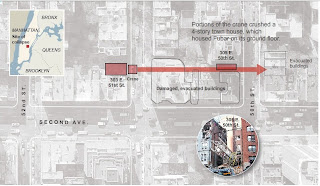
A crane towering over a high-rise construction site on the East Side of Manhattan collapsed in a roar of rending steel Saturday afternoon, raining death and destruction across a city block as it slashed down on an apartment building, broke into sections, crushed a town house and cut away a tenement facade.

At least four people were killed and more than a dozen others were injured, and damage was expected to run into the millions of dollars in what the authorities called one of the city’s worst accidents — a calamity that turned a neighborhood near the UN into a zone of panic, pulverized buildings, wailing sirens, evacuations, searches in the rubble and covered bodies in the streets.

Many residents of the neighborhood around the site of the collapse — 51st Street between Second and First Avenues — said they had been worried for months about the possibility of a collapse, calling the crane, looming higher each week, a menace, particularly because so many residential buildings were being put up in the area with remarkable speed: several floors a week at times.

Christopher Bianchi, 40, of Manhattan, owner of Crave Ceviche Bar on Second Avenue, said he saw three bodies on stretchers in the street. “Their heads were covered,” he said. “One of the police was giving last rites.”

Mayor Michael R. Bloomberg arrived at the scene hours later, surrounded by an army of police officers, firefighters, city officials and reporters. “It’s a sad day,” he said, as the lights of scores of emergency vehicles revolved and flashed. “Our thoughts go out to those who were killed, and we pray that those who were injured will recover.”

As people were evacuated from a half-dozen buildings and rescue workers using dogs, listening devices and thermal imaging cameras searched the rubble for victims — taking care to cause no further collapses — the mayor said the four known dead were believed to be construction workers on or near the crane. The injured included at least three civilians taken to hospitals in critical condition.

One man was pulled from the debris nearly four hours after the collapse.

The dead, all believed to be members of Local 15 of the Operating Engineers Union, were identified as Brad Cohen, Aaron Stephens, Anthony Mazza and Wayne Bleidner.

The cause of the accident on a sunny, windless day was unclear and under investigation by city, state and federal agencies. But Stephen Kaplan, an owner of the Reliance Construction Group working at the site, told The Associated Press that a piece of steel had fallen and sheared off one of the girders holding the crane to the building.

A construction worker on the 15th floor, Ismael Garcia, said he saw something fall and strike one or more of the girder ties, weakening or breaking the connections. “Out of the corner of my eye, I saw a piece falling,” he said, and then the crane pulled away.

The collapse occurred, the mayor said, as workers attempted to jack up the crane, raising its height to enable work to continue above the 19th floor of a planned 43-story building. Builders had city permission to raise the crane, and the crane had been inspected on Friday, with no violations found.

The collapse occurred at 2:22 p.m. as the crane, about 22 stories tall and attached by girders to the apartment tower under construction at 303 East 51st Street, east of Second Avenue, broke away from its anchors and toppled south, across the block between 51st and 50th Streets, as workers at the site and people in high-rises for blocks around looked on, stupefied.

Witnesses told of a rising, thundering roar and clouds of smoke and dust as the crane — a vertical latticed boom for its base, topped by a cab and jib, the swinging arm that lifts building materials — fell across 51st Street and onto a 19-story apartment building at No. 300, demolishing a penthouse and shaking the building with the force of an earthquake.

Mike Shatzkin, a resident of the 17th floor, said he was talking on the phone when it hit. “All of a sudden, I felt a very violent shake, and stuff fell off the walls, and my wife said a bomb went off.” After discovering that their building had been struck by the crane from across the street, he said, “We worried about this crane every day.”

The upper reaches of the crane — including the cab and the extended swinging arm — broke away from the boom, which was left leaning against the facade, and hurtled southward across the block toward 50th Street, tumbling in the air, some witnesses said.

The crane’s blue cab and white jib, itself a latticework of steel, made a direct hit on a four-story town house at 305 East 50th Street, a modern stucco structure with apartments upstairs and a bar called Fubar on the ground floor. The building, on the north side of 50th Street, was demolished.

The bar was not open, and the owner, John P. LaGreco, who had been the proprietor for a decade, said that Juan Perez, 38, a Queens resident and the father of three children, was in Fubar at the time, preparing to open about 4 p.m.

Mayor Bloomberg said one or two people were in the building at the time. The fire commissioner, Nicholas Scoppetta, said that a man, apparently referring to Mr. Perez, was taken alive out of the collapsed town house shortly before 6 p.m. He said there had also been reports of a woman in the building, and search efforts continued late into Saturday night.

In addition to the collapsed town house, the toppling crane jib sheared away the side of a six-story gray tenement building at 301 East 50th, just to the west, exposing tiers of apartments and haunting images of shattered homes: a pink suitcase dangling from the sixth floor, a mattress, a rack of shoes, broken bookshelves.

Debris also damaged buildings on the south side of 50th Street, and bricks demolished parked cars — a dark blue BMW flattened, a Mini Cooper battered with debris.

In the immediate aftermath of the collapse, stunned people rushed into the streets from restaurants and shops, from apartment buildings in the surrounding blocks, many of them unaware of what had happened and fearing the worst.

Within minutes, an armada of fire engines, police cars, ambulances and other emergency vehicles converged on the scene. Water from broken mains was gushing into the street, and an odor of gas was in the air. City and Consolidated Edison workers quickly moved in to cap the leaks and prevent explosions. Throughout the afternoon and evening, traffic was blocked off for blocks around the site.

Some residents of the area saw or heard the collapse from their apartments. Bruce Silberblatt, a retired building contractor who lives at 860 United Nations Plaza, said: “I heard this big double bang. Bang! Then, bang! The first bang must have been the crane hitting the first building, then the second must have been everything else going into the street.”

Scores of evacuated residents from at least a half-dozen damaged or imperiled buildings were offered shelter at the High School of Art and Design, at 228 East 57th Street, the mayor said.

A Fire Department spokesman said that 13 people were injured and taken to area hospitals. Three had critical injuries and two were listed in serious condition, while the rest, including five firefighters, had minor injuries. Four other people were treated at the scene, the spokesman said.

Mayor Bloomberg identified the site’s principal developer as James P. Kennelly, a former firefighter, and the construction company as RCG, an apparent acronym for Reliance Construction Group. He said the crane owner was the New York Crane & Equipment Corporation. The manufacturer, he said, was an Australian company known as Favco, which makes a tower crane with an eight-ton lifting capacity.

“There are no words to describe the level of devastation we feel today as a result of this tragic event,” Mr. Kennelly said in a statement. While the mayor and other city officials said that there had been a relatively small number of violations issued against the construction site in the more than two years since work began, many residents questioned the safety record at the building site.

“We had been very unhappy with the way he was doing his work,” said Mr. Silberblatt, a member of the Turtle Bay Association, a civic group. He cited debris in the streets, a lack of a sidewalk bridge, and other faults.

According to records from the New York City Department of Buildings, the agency has issued 14 violations against contractors doing work at the site, 10 of them against RCG. The citations were issued between Jan. 17, 2006, and Feb. 8 of this year. The violations included failure to safeguard the public and property and failure to provide roof protection on adjacent property.

A Buildings Department spokeswoman, Kate Lindquist, said that of the 14 violations, 13 remained “open” — meaning that a court date is pending or the company did not appear at a scheduled court hearing and the violations are in default status.

Ms. Lindquist said that Buildings Department inspectors performed an inspection of the site Saturday morning in preparation for predicted high winds. Upon inspection, she said, a partial stop-work order was issued to halt all concrete operations at the site. The order was issued because inspectors found material stored too close to the building’s edge on several floors. The order did not apply to the extending of the crane, which was under way at the time of the accident, she said.

The last major crane collapse at a construction site in New York occurred in September 1999, when a 383-foot crane fell at 24th Street and the Avenue of the Americas, crushing a carpenter and injuring three other people.

Thursday, March 13, 2008

Poor Gov. Eliot Spitzer and wifee Silda Wall


The Fed's worst nightmare

Ugly retail sales and a somber forecast from CFOs point to recession, but rising oil and gold prices and a weak dollar show inflation. What's Ben Bernanke to do?

By Paul R. La Monica, CNNMoney.com editor at large

Last Updated: March 13, 2008: 12:48 PM EDT

NEW YORK (CNNMoney.com) -- It's days like today that will make many investors wish they stayed in bed.

And they're not the only ones. Something tells me that Ben Bernanke and the rest of the Federal Reserve's policy-making committee would like to run and hide as well.

Where to begin? Retail sales for February were shockingly weak, with sales falling 0.6% during the month compared to economists' forecasts of a 0.2% gain. Those numbers put dents in the argument that consumers would keep spending in the face of the housing downturn.

Wall Street is also digesting some sobering results from a survey of chief financial officers released by Duke University and CFO magazine late Wednesday.

According to the survey of more than 1,000 CFOs, conducted last week, three-quarters of the respondents said the economy is either in a recession already or will hit one this year, and nearly 90% of CFOs surveyed said they didn't think the economy would rebound until late 2009.

So this means the Fed should slash interest rates at its next meeting on March 18, right? After all, according to federal funds futures, investors are pricing in a 72% chance of a three-quarters of a percentage point cut.

But not so fast.

Gold hit $1,000 an ounce for the first time ever Thursday morning. Oil is slouching towards $111 a barrel. And the dollar hit a 12-year low against the yen and a new record low against the euro. Can you say inflation?

 Actually, it's worse than mere inflation. The combination of rising commodity prices and the weakening growth forecast for the economy has people worried about 1970s style stagflation. I hope Bernanke can dig up a pair of old bell bottom pants. Do the hustle!

"Clearly, the Fed needs to switch to Plan B," noted Duke professor Campbell R. Harvey in a release about the CFO survey.

But what is Plan B exactly? It's difficult to figure out just what the Fed can do other than let the credit markets and housing markets work themselves out, and hope the actions the central bank has already taken stimulate the economy at some point.

Time may be the Fed's only ally

Even though the Fed's series of rate cuts since last September - as well as the hundreds of billions in cash and Treasurys that the central bank has pledged to loan capital-constrained financial institutions - have failed to encourage more lending just yet, investors and consumers need to realize there is a lag effect of several months before Fed policy moves have an impact. History shows that Fed easing will eventually work their magic.

Hopefully, the rate cuts will encourage more banks to loosen their lending standards again, and will spur consumers and corporations to start spending more by the end of 2008 or early 2009.

Plus, even though there is a debate about whether the tax rebate checks that consumers will receive in the next few months will really help the economy that much, it's hard to see how the rebates can hurt.

But as I've said earlier this week in this column and numerous times before that, the Fed cannot drop the ball on inflation even if there are more signs of severe economic weakness. On Friday morning, we'll find out how much consumer prices rose in February.

Economists are predicting a 0.3% rise in the headline Consumer Price Index (CPI) number and a 0.2% increase in the so-called core number, which excludes volatile food and energy costs.

If the CPI figures are higher than expected, the Fed may have no choice but to disappoint Wall Street next week and only cut interest rates by a half-point, or perhaps even only by a quarter-point.

A quick fix for the economy is not what's needed. The Fed has to ensure that its actions don't lead to the type of double-dip, or W-shaped recession, that some economists and market strategists are now talking about.

Harvey indicated this could be the longest slowdown since the double-dip of 1979 to 1981. But if the Fed holds firm and doesn't stoke even greater inflation by lowering its key federal funds rate that much further, perhaps there's a chance this slowdown will turn into, at worst, just your garden-variety recession - and not an unwelcome rerun of what happened in the 1970s.

Friday, March 07, 2008

MADISON SQUARE PARK


6.234 acres in NYC

Madison Square Park is named for James Madison (1751-1836), a Virginian who was the fourth President of the United States (1809-17). Madison earned the title "father of the Constitution," from his peers in the Constitutional Convention. He also co-authored The Federalist Papers (1787-88) with New Yorkers Alexander Hamilton and John Jay. Madison was Secretary of State from 1801-09, serving through both of President Thomas Jefferson's terms. As President, he was Commander-in-Chief during the War of 1812 with the British. Madison was the rector of the University of Virginia from 1827 until he died in 1836.

The largest parcel of this land was first designated as public property when Royal Governor Thomas Dongan revised the City Charter in 1686. Since then, this area has been used for a variety of public purposes. A potter's field was established here in 1794, and then was moved in 1797 to Washington Square. By 181 1 the land was home to a United States Army Arsenal (1806) and laid out as part of a military parade ground (named for Madison in 1814), bounded by 3rd and 7th Avenues and 23rd and 34th Streets. The arsenal fell out of military use, and served as a "House of Refuge" for juvenile delinquents from 1825 until 1839, when it was destroyed by fire.

After being leveled, sodded, and enclosed, Madison Square Park opened to the public on May 10, 1847, with boundaries of Fifth Avenue and Madison Avenues and 23rd and 26th Streets. Citizens quickly claimed the public park as their own. Their protests against plans to erect the Crystal Palace here in 1853 resulted in its relocation to Bryant Park. Nevertheless, the park has been host to grand celebrations, replete with temporary decorative arches, to commemorate historic occasions and anniversaries such as the centennial of the signing of the Declaration of Independence in 1876 and the triumphant return of Admiral Dewey from t he Spanish American War in 1899.

The original Madison Square Garden was located adjacent to the park at Madison Avenue and 26th Street. It was owned by William Vanderbilt, and opened in 1879. The building was razed in 1899 and replaced with a Moorish style building designed by Stanford White. The second Madison Square Garden stood until 1925 when it was demolished and replaced by the headquarters of the New York Life Insurance Company. Promoter Tex Rickard built the third Garden that same year at 8th Avenue and 50th Street. to read more go to:

http://www.nycgovparks.org/sub_your_park/historical_signs/hs_historical_sign.php?id=10764

Saturday, March 01, 2008

Remember the co-op


March 2, 2008

Reducing the Tax Bite on Apartment Sales

By JAY ROMANO

MOST co-op and condominium owners know they get income-tax deductions for the mortgage interest and property taxes they pay on their apartments.

But what they may not know is the full range of tax breaks available when their apartments are sold.

“As a starting point, many owners of co-ops and condos overstate their profit when they sell because they understate their tax basis,” said Julian Block, a tax lawyer in Larchmont, N.Y. “And that is because they fail to take into account improvements made to the building itself and in the case of co-op owners, their share of the amortization of the building’s mortgage.”

At present, Mr. Block said, owners who sell their houses or apartments can exclude up to $250,000 in profits on the sale, provided the home was their principal residence for two of the five years before the sale. (For married couples filing jointly, the exclusion is up to $500,000.)

The profit — or capital gain — is calculated by subtracting the tax basis of the home and the costs associated with the sale (broker’s commission, lawyer’s fees, transfer taxes) from the sale price. The tax basis is the acquisition price plus the costs associated with the purchase and any capital improvements.

Co-op or condo owners are covered by these rules, just as any other homeowner is. So, for example, an apartment owner who completely renovates the kitchen can add the cost to the tax basis. But an owner who simply paints the kitchen walls cannot add that cost to the tax basis because routine maintenance is not considered a capital improvement.

What is unique for owners of co-ops and condos is that they can include in their basis their proportionate amount of the money spent for buildingwide capital improvements.

“Over the years, this can amount to a significant amount of money,” Mr. Block said.

Co-op owners get an additional tax break. Along with an annual deduction for interest paid on the mortgage on their apartments, co-op owners also get to increase their tax basis for their share of payments that reduce the principal of the building’s mortgage. This does not apply to condo owners because there is no mortgage on the building itself.

“And there is yet another way for a co-op or condo owner to reduce capital gains,” Mr. Block said. Many co-ops and some condos impose flip taxes, often a small percentage of the sale price. Since the flip tax is really a transfer fee, the seller can subtract it from the sale price as a cost of the sale, thereby further decreasing the gain realized.

Joel E. Miller, a Queens tax lawyer, said that since co-ops and condos keep detailed financial records, it should be fairly easy for owners to determine their share of qualifying capital improvements made over the years — as well as their share of the amortization of the underlying mortgage — by getting the information from the managing agent.

But he added that it was up to individual owners to keep accurate records of capital expenditures made in their own apartments.

Go RedBull

March 1, 2008

The Art of the Save, for Goalie and Investor

By PATRICIA COHEN

When it comes to choosing what to do, sometimes the best thing is nothing.

Consider Radek Cerny, the No. 1 goalkeeper for Tottenham Hotspur, who was facing off against Manchester United’s exuberant young midfielder, Cristiano Ronaldo, for a penalty kick during the recent fourth round of the Football Association Cup in Britain. As Ronaldo’s foot swung back for the kick, Cerny leapt to the left expecting a sharp shot to that corner. The ball barreled into the lower right.

Goal!

Cerny’s mistake, in Ofer H. Azar’s eyes, is that he moved to one side instead of remaining in the center, where he would have had a greater chance of stopping the ball.

Mr. Azar is not a coach or a goalie. Actually, he does not even play soccer. He’s a lecturer in the School of Management at Ben-Gurion University of the Negev in Israel. Mr. Azar, however, is interested in decision-making, and the split-second response of goalies to penalty kicks struck him and several of his colleagues as a perfect real-life test case of why people sometimes make irrational decisions.

Classical economists often criticize experiments on how emotions influence financial decisions because they do not involve meaningful monetary rewards. Examining professional soccer players seems to solve that problem.

“Incentives are huge,” Mr. Azar and his collaborators argue in a paper that appeared not long ago in The Journal of Economic Psychology. What’s more, “goalkeepers face penalty kicks regularly, so they are not only high-motivated decision-makers, but also very experienced ones.”

The Israeli scholars are not looking to break into the Premier League. Their point is that a preference for action over inaction can play a significant role in all kinds of economic choices.

When the economy has been doing poorly, officials are more likely to “be tempted to ‘do something,’ ” they argue, even if the risks outweigh the possible gains. “If things turn bad, at least they will be able to say that they tried to do something, whereas if they choose not to change anything and the situation continues to be poor (or becomes worse), it may be hard to avoid the criticism that despite the warning signs they ‘didn’t do anything.’ ”

That sort of thinking can affect whether managers stick with their firm’s current strategy or change course. And, apparently, whether goalkeepers stand still or take a leap.

The soccer field has turned out to be a popular laboratory among economists, with penalty kicks a particular favorite.

Awarded after certain kinds of fouls, or sometimes to decide a championship match, a penalty kick pits one player against the goalkeeper. (Mano a pie instead of mano a mano, though, since the goalie is allowed to use his hands.)

Standing just 36 feet away, the kicker sends the ball hurtling at the goal at 60 to 80 m.p.h., giving the goalie just 0.2 to 0.3 second to respond. Given the speed, the goalkeeper has to decide what to do even before observing the direction of the kick. Stopping a penalty kick is considered one of the most difficult challenges in sports. Not surprisingly, 80 percent of all penalty kicks score.

For their study, Mr. Azar, along with Michael Bar-Eli, a sports psychologist; Ilana Ritov, a psychologist; and two graduate students, scanned the top leagues in the world, collecting data on 311 penalty kicks. Then they computed the probability of stopping different kicks (to the left, the right or center) with different actions (jumping left, right, or staying put) to see which one “maximizes his chance of stopping the ball.”

According to their calculations, staying in the center gives the goalkeeper the best shot at halting a penalty kick — 33.3 percent, instead of 14.2 percent on the left and 12.6 percent on the right.

Yet when the group analyzed how the goalkeepers had actually reacted to these penalty kicks, they discovered the goalies remained in the center just 6.3 percent of the time.

The reason, Mr. Azar contends, is rooted in how the players feel after failing to block the ball.

Their soccer speculations build on the work of Amos Tversky and the Nobel Prize winner Daniel Kahneman, who explored the idiosyncrasies of decision-making. In a landmark study, the two psychologists found that people had more regrets when they lost $1,200 because they chose to act, (in this case, change an investment), than people who lost $1,200 because they left their investments untouched.

What Mr. Azar and his collaborators wanted to show was that in certain situations, those results could be reversed: when acting was the standard response — like a goalkeeper’s jumping to one side on a penalty kick — not acting would make someone feel a deeper emotional pang. The result is an unconscious bias toward action.

To check, they asked 32 goalkeepers in Israel’s Premier League and National League to rate how bad they felt on a scale of 1 to 10 after missing penalty kicks. As it turned out, about half of the group said “10” no matter where they stood.

Of the remaining 15, 11 felt worse when they remained in the center instead of jumping to the side. Nothing definitive, the authors acknowledge, but it does at least suggest “that goalkeepers feel worse about a goal being scored when it follows from inaction (staying in the center) than from action (jumping).”

Outside the stadium, Mr. Azar and company argue that “action bias” can influence not just goalies but also investors as they decide to sell their stocks (action) or leave their portfolio untouched (inaction) during a downturn, and whether a worker chooses to look for a better job or stay put.

Marcel Zeelenberg, a social psychologist at Tilburg University in the Netherlands, has found that a bias toward action or inaction often depends on whether a previous result was good or bad. After a team has a big loss, for example, the expectation is that the coach should replace the starting players, whereas after winning, leaving the lineup unchanged is considered the normal response.

In an e-mail message, Mr. Zeelenberg said he thought the Israelis’ “paper is convincing because it uses real, already existing data to test a theory that was recently developed and tested only in the lab.”

Paul Romer, an economist at the Graduate School of Business at Stanford University, said the study illustrated an important point about economic decision-making.

“How people feel about various kinds of activities means a lot about what they decide to do,” Mr. Romer said. “In many situations, we just look at the narrow monetary payoffs and we forget about the effects of preference or feelings.”

For instance, going to school for an extra year will mean higher wages in the long run, Mr. Romer said, but “going to school can be very rewarding and satisfying for some, and very painful for others.” By looking solely at the financial rewards, “you might miss the single most important factor in determining that decision.”

Shame, humiliation, feelings about one’s competence — all of these emotions play a huge role in decision-making.

“There is a very large social component to feelings,” Mr. Romer said. “Economists typically assume that people understand what makes them feel good,” but “people actually don’t always understand what makes them happy.”

So what do the men on the field think?

Danny Cepero, a goaltender with the New York Red Bulls, said he could understand the emotional downside of doing nothing. If you stay put because you think a ball is coming straight up the middle and miss, he said, “you look like a fool.

“Definitely it’s more acceptable to pick a side and just go.”

Still, Mr. Cepero was skeptical that staying in the center makes the most sense. “You rarely see a goalkeeper stand in the middle and make a save,” he insisted.

To Des McAleenan, the Bulls’ goaltending coach, no computer analysis can capture the complexity of players’ responses. “Now, everybody’s got extensive dossiers on the opposition,” he said.

The journal article does point out that the center strategy is not an absolute rule; if goalkeepers spend more time in the middle, penalty kickers would undoubtedly shift their strategy and their aim.

But for the moment, Mr. Azar’s team would advise those who play soccer or the market that nothing is sometimes better than something.